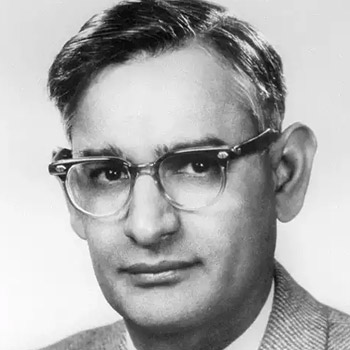
Prasanta Chandra Mahalanobis
Prasanta Chandra Mahalanobis was a pioneering Indian statistician and scientist whose work laid the foundation for modern statistical practices in India. Born on June 29, 1893, in Calcutta (now Kolkata), he transformed from a physicist into a global leader in applied statistics, influencing economics, anthropology, and national planning.
Early Life and Education
Mahalanobis hailed from a prominent Brahmo family in Calcutta, receiving his early education at Brahmo Boys' School and Presidency College. He earned a BSc in physics in 1912 and later studied at King's College, Cambridge, obtaining a natural sciences tripos in 1915, where he honed his mathematical skills. Returning to India, he joined Presidency College as a physics lecturer in 1917, but his curiosity soon drew him toward statistics through meteorological and anthropometric studies.
Statistical Innovations
Mahalanobis is best known for inventing the Mahalanobis distance (D²), a multivariate measure that accounts for correlations between variables, revolutionizing fields like taxonomy, pattern recognition, and economics. He applied it early in analyzing shell variations in snails and human cranial data, establishing rigorous sample survey methods for crop yields and floods in Bengal. His over 200 publications spanned meteorology, anthropology, and fractile graphical analysis, earning acclaim from statisticians like Ronald Fisher.
Founding the Indian Statistical Institute
In 1931, Mahalanobis established the Indian Statistical Institute (ISI) in Calcutta as a small statistical laboratory, which grew into a world-class center under his leadership. By 1950, with government support, ISI expanded to include research schools and purchased land for its campus, training generations of statisticians and pioneering large-scale surveys. He also helped create the National Sample Survey and Central Statistical Organization, bolstering India's data infrastructure.
Role in National Planning
As a key member of India's first Planning Commission, Mahalanobis shaped the Second Five-Year Plan (1956-1961) with his economic model emphasizing heavy industry over consumer goods, adapting Leontief's input-output framework. His flood studies informed projects like Hirakud and Damodar Valley dams, blending statistics with development. He advised Prime Minister Jawaharlal Nehru on perspective planning for underdeveloped economies.
Cultural Ties and Legacy
A close associate of Rabindranath Tagore, Mahalanobis served as secretary during Tagore's travels and contributed to Visva-Bharati University. He received the Padma Vibhushan in 1968, Fellowships of the Royal Society (1945) and Indian National Science Academy, and an OBE. Mahalanobis passed away on June 28, 1972, leaving an enduring impact as the "father of Indian statistics."