Indian States and Union Territory - Uttarakhand
Chief Minister: Mr. Pushkar Singh Dhami
Governor: Lt. Gen. Gurmit Singh, PVSM, UYSM, AVSM, VSM (Retd.)
Area: 53,484 sq. km sq. km
Capital: Dehradun
Population: 1,01,16,752
Male Population: 88
Female Population: 70
Total Literacy(%): 79.63
Male Literacy(%): 88.33
Female Literacy(%): 70.70
Sex Ratio: 963
No of District: 13
Principal Languages: Hindi
Other Languages: Hindi, Garhwali, Kumaoni 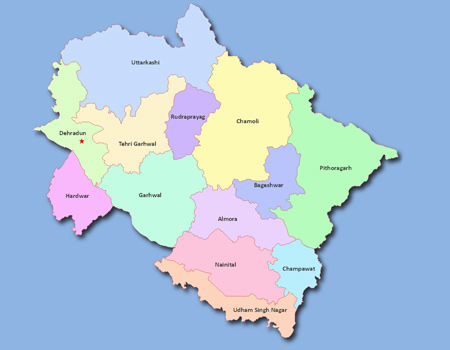
Uttarakhand is a unique Indian state known for its rich history, diverse geography, farming traditions, expanding industries, abundant water resources for power, extensive transport networks, vibrant festivals, and popular tourist destinations.
History and Geography
Uttarakhand, also called the “Land of Gods” or “Devbhoomi,” was formed in 2000 from the northern parts of Uttar Pradesh. Its history extends back to the Stone Age with archaeological evidence of ancient settlements, particularly in the Kumaon and Garhwal regions. Historically, the area comprised the Garhwal and Kumaon kingdoms with distinct cultural identities but strong regional bonds. The creation of Uttarakhand as a state was driven by cultural unity and political movements in the 1990s. Geographically, the state covers about 53,483 sq km with 86% mountainous terrain and 65% forest cover. It lies on the southern slope of the Himalayas, featuring high peaks like Nanda Devi at 7,817 meters, glaciers, and varied ecosystems from alpine to tropical forests.
Agriculture
Agriculture is mainly subsistence and rainfed, covering 0.8 million hectares or about 16% of the state's area. Around 55% of cultivated land depends on rainfall, with rice, wheat, and maize as staple crops. The state's agro-climatic conditions favor horticulture, floriculture, and medicinal plant cultivation. There are challenges like soil nutrient depletion and pest attacks, but interventions are ongoing to sustain productivity. The diverse farming supports a mix of food security and local market needs.
Industry
Uttarakhand's industrial sector has grown rapidly, transforming from a backwater economy to one with 80,000 new businesses in 25 years, particularly in MSMEs. Key industries include information technology, pharmaceuticals, biotechnology, agro processing, engineering, and fast-moving consumer goods. The state government has promoted investment through multiple industrial zones managed by SIDCUL and policy frameworks facilitating ease of doing business while balancing ecological concerns.
Irrigation and Power
The state harnesses substantial hydropower potential from its rivers flowing down the Himalayas. Projects like the Tehri Dam, Maneri Bhali hydroelectric project, and the ongoing Song and Jamarani dam constructions exemplify efforts to produce sustainable electricity and manage water resources. The Uttarakhand Irrigation Department focuses on canal construction, reservoirs, tube wells, and flood control to aid agriculture and water conservation.
Transport
Road connectivity has improved significantly with all-weather highways, bridges, and tunnels linking remote areas and tourist centers. The state benefits from good connectivity to Delhi and neighboring states. Rail and air transport also support tourism and trade growth, facilitating economic development.
Festivals
Uttarakhand celebrates many vibrant festivals rooted in Hindu traditions, reflecting its spiritual heritage. Important festivals include Kumbh Mela, celebrated in Haridwar, Nanda Devi Raj Jat, and religious events at temples like Kedarnath and Badrinath. Local fairs and cultural occasions regularly draw pilgrims and tourists, showcasing folk music, dance, and local cuisine.
Tourist Centres
Tourism is crucial, with destinations like Rishikesh (spiritual center and yoga hub), Haridwar (holy city), Nainital (hill station), Mussoorie (queen of hills), Jim Corbett National Park (wildlife sanctuary), Auli (ski resort), and Hemkund Sahib (Sikh pilgrimage). The state's pristine landscapes, trekking routes, pilgrimage sites, and adventure tourism attract diverse visitors year-round.
This comprehensive profile portrays Uttarakhand as a state that balances its ancient heritage and ecological wealth with modern economic development and infrastructure progress. Its unique geography, strong cultural identity, and natural resources shape its growing significance in northern India.