Indian States and Union Territory - Uttar Pradesh
Chief Minister: Yogi Adityanath
Governor: Smt. Anandiben Patel
Area: 2,40,928 sq. km sq. km
Capital: Lucknow
Population: 19,95,81,477
Male Population: 79
Female Population: 59
Total Literacy(%): 69.72
Male Literacy(%): 79.24
Female Literacy(%): 59.26
Sex Ratio: 908
No of District: 71
Principal Languages: Hindi
Other Languages: Hindi and Urdu 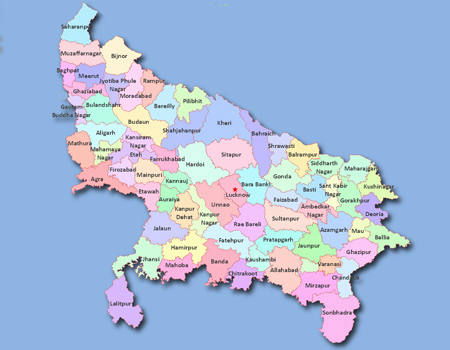
Uttar Pradesh (UP) is a significant and diverse state located in northern India, rich in history, culture, and economic activity. Here is a detailed and unique article covering its history and geography, agriculture, industry, irrigation and power, transport, festivals, and tourist centers.
History and Geography
Uttar Pradesh lies in the north-central part of India, largely encompassing the fertile Indo-Gangetic plains. Historically, it was the core region of ancient and medieval empires. The region reached its zenith during the reign of Emperor Harshavardhana (590–647), covering much of northern and central India. Later, it became the heartland of the Mughal Empire, starting from Babur’s conquest in 1526. The state has witnessed crucial historical events such as the Indian Rebellion of 1857 in cities like Jhansi, Meerut, Kanpur, and Lucknow, playing a pivotal role in the independence movement. Today, Uttar Pradesh is bordered by Nepal to the north, Bihar to the east, and other Indian states on all sides, covering about 240,928 sq. km after the reorganization of its territory.
Agriculture
Agriculture remains the backbone of Uttar Pradesh's economy. The state produces major crops like rice, wheat, and sugarcane. Since the late 1960s, agricultural productivity has improved due to high-yield seed varieties, better fertilizers, and expanded irrigation, positioning UP as a leading food grain producer in India. However, many farmers still face challenges such as small landholdings and limited investment capacity in modern technology. Besides crops, livestock, and dairy farming also contribute significantly to rural incomes.
Industry
Uttar Pradesh has a growing industrial sector supported by a well-developed infrastructure. The State Industrial Development Corporation (UPSIDC) manages industrial areas, growth centers, and special economic zones (SEZs). The state has 15 industrial areas, 12 specialized parks, and 19 notified SEZs that attract investment and boost manufacturing. Textiles, sugar, cement, and electronics are among the key industries. Lucknow, Kanpur, Noida, and Ghaziabad are major industrial hubs.
Irrigation and Power
Irrigation infrastructure in Uttar Pradesh is extensive, relying heavily on the river Ganga and its canals, established originally during British colonial times. Major irrigation projects include the Eastern Ganga Canal, Upper Ganga Canal, and Sarda Sahayak project. Tube wells and wells also supplement irrigation, especially in areas without canal access. Despite its benefits, groundwater depletion due to over-extraction and poor water management poses challenges. Efforts to modernize irrigation with micro-irrigation, rainwater harvesting, and groundwater recharge are underway. Power supply is critical for agriculture and industry, with state efforts to expand power generation and distribution.
Transport
Uttar Pradesh boasts a vast transport network comprising roads, railways, airways, and inland waterways. The state is connected by 48 national highways and an extensive railway network linking major cities internally and to other parts of India. Airports in cities such as Lucknow, Varanasi, and Kanpur facilitate domestic and limited international flights. Rivers Ganga, Yamuna, and Ghaghara also serve as inland waterways, supporting cargo and passenger movement. These transport systems are vital for economic development and tourism.
Festivals
Uttar Pradesh is culturally vibrant with many festivals celebrated across communities:
- Hindu festivals: Diwali, Holi, Dussehra, and Makar Sankranti are widely celebrated.
- Muslim festivals: Eid-ul-Fitr and Eid-ul-Adha have a large observance.
- Other notable festivals include the Kumbh Mela held in Prayagraj, attracting millions of pilgrims worldwide.
These festivals reflect UP’s pluralistic society and rich heritage.
Tourist Centres
Uttar Pradesh is a major tourist destination with numerous historic, religious, and cultural sites:
- Agra: Home to the Taj Mahal, Agra Fort, Fatehpur Sikri, and Mehtab Bagh.
- Varanasi: One of the world’s oldest living cities, famous for ghats along the Ganges, Sarnath, and many ancient temples.
- Prayagraj (Allahabad): Known for the Triveni Sangam and Kumbh Mela.
- Ayodhya: Birthplace of Lord Rama, an important pilgrimage site.
- Mathura and Vrindavan: Associated with Lord Krishna.
- Historic places like Jhansi, Lucknow, and Kannauj also offer cultural experiences.
These tourist centers attract millions annually, contributing significantly to the state's economy.
In conclusion, Uttar Pradesh combines a rich historical past with dynamic contemporary development in agriculture, industry, and infrastructure. Its cultural festivals and world-renowned tourist sites make it a unique blend of tradition and progress.