Indian States and Union Territory - Tripura
Chief Minister: Dr. Manik Saha
Governor: Shri Indra Sena Reddy Nallu
Area: 10,491.69 sq.km
Capital: Agartala
Population: 36,71,032
Male Population: 92
Female Population: 83
Total Literacy(%): 87.75
Male Literacy(%): 92.18
Female Literacy(%): 83.15
Sex Ratio: 961
No of District: 4
Principal Languages: Bengali
Other Languages: Bengali and Kokborok 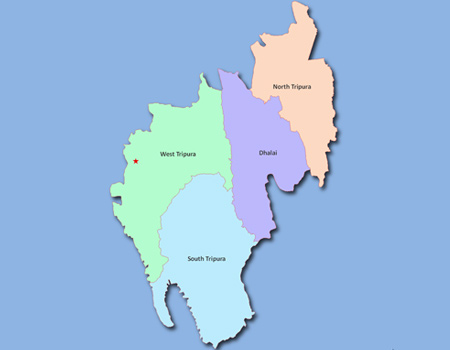
Tripura is a unique northeastern state in India with a rich history, diverse geography, an agriculture-driven economy, an emerging industry, and vibrant cultural life.
History and Geography
Tripura, one of India's smallest states with an area of about 10,491 sq km, is located in the northeastern part of the subcontinent, surrounded on three sides by Bangladesh and bordered by Assam and Mizoram in the northeast. The region was once a princely state that merged with India in 1949. Historically, Tripura’s boundaries extended to the Sundarbans in the south and reached the Burmese frontier in the east. The state faced several Muslim invasions starting in the 13th century, followed by periods of Mughal influence mainly in the plains, while the hilly regions remained under the Tripuri rulers' control.
The geography is marked by hills and sub-mountains primarily in the central and eastern areas, with red laterite soil in the hills and alluvial soil in floodplains and valleys, which supports agriculture. Forests cover more than 60% of the land, rich in bamboo and cane, and the state is known for its biodiversity, including a high number of primate species. Major rivers such as Gumti, Manu, and Dhalai flow through Tripura, contributing to its irrigation resources. The climate is tropical, warm, and humid, making it suitable for agriculture.
Agriculture
Agriculture is the backbone of Tripura’s economy, supporting over 75% of the workforce. Around 24.3% of the land is reserved for agriculture, with about 2.5 lakh hectares under cultivation. Rice is the principal crop, supplemented by jute, sugarcane, wheat, oilseeds, coconut, and turmeric. The state also has a significant plantation economy, being the second-largest rubber producer in India. The government actively promotes new technologies, improved seeds, fertilizers, and protective chemicals to boost agricultural productivity. Additionally, bamboo and medicinal plants are among the important forest-based products that contribute to livelihoods. Efforts to improve irrigation, including the installation of solar-powered pumps, are underway to support sustainable agriculture and reduce dependency on traditional energy sources.
Industry
Tripura’s industry is diverse, though still developing. Key industries include natural gas exploitation, rubber processing, food processing, tea cultivation, bamboo-based industries, handloom, handicrafts, and sericulture. The presence of natural gas and petroleum reserves supports gas-based power plants, contributing to energy generation and industrial use. Agartala, the capital, serves as the commercial and logistics hub with emerging agro-industries and cross-border trade centers in other districts such as Dharmanagar and Belonia.
Irrigation and Power
Irrigation in Tripura heavily relies on its river systems and rainfall. The government promotes schemes like the PM Kusum scheme, enabling farmers to access solar-powered irrigation pumps at subsidized rates through the Tripura Renewable Energy Development Agency (TREDA). This promotes green energy, improves irrigation reliability, and expands the irrigated area, boosting overall agriculture. The state also has power generation capacity linked to natural gas reserves, enhancing energy availability for domestic and industrial needs.
Transport
Tripura’s transport infrastructure is primarily road-based, managed by the Tripura Road Transport Corporation (TRTC), which oversees public road transport and regulation. The transport network connects the state internally and links to neighboring states and Bangladesh for cross-border trade. The state government continues to invest in road construction and management to improve mobility and economic integration. Agartala is the main transport hub, offering bus, taxi, and logistics services.
Festivals
Tripura’s cultural life is vibrant, with festivals reflecting its tribal and non-tribal communities. Major festivals include:
- Garia: Celebrated in April, this festival symbolizes devotion and prosperity. It involves the Garia dance, religious pujas by priests (Ochai), singing, and drumming.
- Kharchi: Held in July, it is linked to the royal history of Tripura. Fourteen deities’ head images are worshipped, accompanied by religious and cultural programs attracting diverse participation.
These festivals underscore the composite cultural tradition of Tripura and are supported by the state government with sponsorship and promotion.
Tourist Centres
Tripura offers several tourist attractions blending natural beauty, history, and culture:
- Unakoti: Famous for its ancient rock carvings and sculptures.
- Neermahal: A water palace situated in a lake, showcasing royal heritage.
- Jampui Hills: Known for scenic landscapes, orange orchards, and trekking.
- Religious and historical temples, rivers, and wildlife sanctuaries add to the appeal.
Tourism is recognized as a growing sector complementing the economy and providing livelihood opportunities.
This detailed overview highlights Tripura’s rich history, fertile landscape, agricultural prominence, growing industries, commitment to renewable irrigation technologies, improving transport infrastructure, cultural vibrancy, and tourist potential, making it a distinctive and evolving state in India's Northeast.