Indian States and Union Territory - Telangana
Chief Minister: Shri A Revanth Reddy
Governor: Shri Shiv Pratap Shukla
Area: 112,077 sq. km sq. km
Capital: Hyderabad
Population: 3,51,93,978
Male Population: 75
Female Population: 57
Total Literacy(%): 66.54
Male Literacy(%): 75.04
Female Literacy(%): 57.99
Sex Ratio: 988
No of District: 31
Principal Languages: Telegu
Other Languages: Telegu 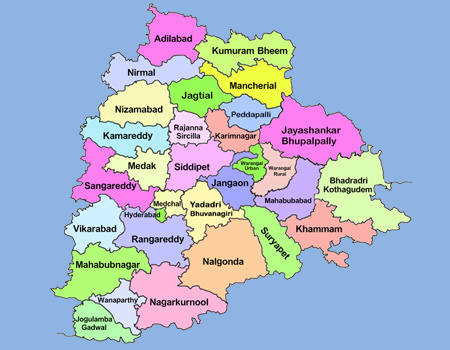
Telangana, the dynamic 29th state of India, has rapidly emerged as a vibrant hub blending ancient history, diverse geography, robust agriculture, advanced industry, innovative irrigation, powerful energy initiatives, substantial transport infrastructure, rich festivals, and unique tourist destinations.
History and Geography
Telangana's story stretches back millennia, with evidence of human habitation found in every district. The region was once ruled by the great Satavahana, Kakatiya, and Asaf Jahi dynasties, followed by the Golconda Sultanate. Its integration into the Indian Union occurred in 1948, after Hyderabad's resistance, and the movement for a distinct state led to Telangana's formation in 2014, with Hyderabad as its capital.
Geographically, Telangana sits on the Deccan Plateau, covering 112,077 sq km. It is largely arid but is drained by major rivers such as the Godavari and Krishna. The region is characterized by semi-arid conditions, red sandy loams, black cotton soils, and receives 700–1500 mm of annual rainfall depending on the region. Major cities include Hyderabad, Warangal, Nizamabad, and Karimnagar.
Agriculture
Agriculture is foundational in Telangana, with over 53.5 lakh hectares under cultivation across Kharif and Rabi seasons. The state's major crops include rice, which dominates, followed by cotton, sugarcane, mango, tobacco, sunflower, peanuts, and pulses. The government actively steps in to support farmers, approving procurement plans for crops like moong, urad, and soybean under schemes such as PM-AASHA and Price Support Schemes. Notably, for Kharif 2025–26, Telangana has seen massive procurement drives ensuring fair compensation for farmers.
Industry
Telangana's industrial contribution remains robust, with approximately 18% of its Gross State Value Added (GSVA) stemming from the sector in 2023 - 24. Key subsectors, mining (notably coal from Singareni Collieries), manufacturing, and construction have shown significant growth, especially in pharmaceuticals, electronics, automotive, and textiles. Telangana leads in IT exports and adopts innovative policies to attract investment, foster Industry 4.0/5.0 practices, and empower MSMEs with advanced technologies. Centers of Excellence and initiatives such as TG-iPASS and Hyderabad Pharma City further encourage sustainable growth. There is also a push to expand to electric vehicles, semiconductors, and renewable energy.
Irrigation and Power
Irrigation in Telangana revolves around the Godavari and Krishna rivers, with many projects underway, including multi-state and lift irrigation schemes. The massive Nagarjuna Sagar Dam supports agriculture and power. Recent policies encourage solarization of irrigation pumps, 16,840 pumps via PM KUSUM and departmental solar installations—reducing dependency on conventional energy and propelling clean energy goals. As of March 2025, the state boasts an installed power capacity exceeding 20,400 MW, with a mix of state utilities, central utilities, and private sector contributions. Plans to establish new distribution companies and underground cabling in cities like Hyderabad are in motion to modernize the sector.
Transport
Transport infrastructure in Telangana sees constant upgrades. The state is connected by national highways and roads, facilitating travel between major cities like Hyderabad, Bengaluru, Vijayawada, and more. Major projects for rural road upgrades worth over Rs 62.9 billion have been proposed to enhance connectivity in remote areas. The government enforces strict safety regulations and speed limits on intercity routes, especially after recent high-profile accidents, with probes and policies to safeguard passengers.
Festivals
Telangana's festivals reflect its rich heritage and local customs. The world-renowned Bathukamma (colorful floral festival unique to Telangana women), Bonalu (offering to goddess Mahakali), Kakatiya, Makara Sankranti, Ugadi (Telugu New Year), and Deccan Festival are major celebrations. Other pan-Indian and religious observances include Dussehra, Ramzan, Christmas, Moharram, and Sammakka Saralamma Jatara—Asia’s largest tribal festival. These festivals offer a glimpse into the region's arts, music, food, and community warmth, drawing tourists globally.
Tourist Centres
Telangana is rich in heritage and leisure destinations. Hyderabad, the “city of Nizams,” is famous for its iconic Charminar, sprawling Golconda Fort, elegant Chowmahalla Palace, Hussain Sagar Lake, and Ramoji Film City, the world's largest integrated film studio complex. Other important destinations include Warangal (its historic fort), Nizamabad, Medak, Khammam, and Karimnagar. Each site offers insights into ancient dynasties, architectural marvels, and vibrant markets. Culinary experiences such as the legendary Hyderabadi Biryani make the state a gastronomic delight.
Conclusion
Telangana is a compelling blend of timeless history and modern progress, marked by its geographical distinction, agrarian richness, industrial dynamism, innovative irrigation and power policies, evolving transport system, festive spirit, and remarkable tourist attractions. The state's rapid development and cultural vibrancy continue to make it one of India's most promising regions for residents and visitors alike.