Indian States and Union Territory - Tamil Nadu
Chief Minister: C Joseph Vijay
Governor: Shri Rajendra Vishwanath Arlekar
Area: 1,30,058 sq. km sq. km
Capital: Chennai
Population: 7,21,38,958
Male Population: 86
Female Population: 73
Total Literacy(%): 80.33
Male Literacy(%): 86.81
Female Literacy(%): 73.86
Sex Ratio: 995
No of District: 32
Principal Languages: Tamil
Other Languages: Tamil 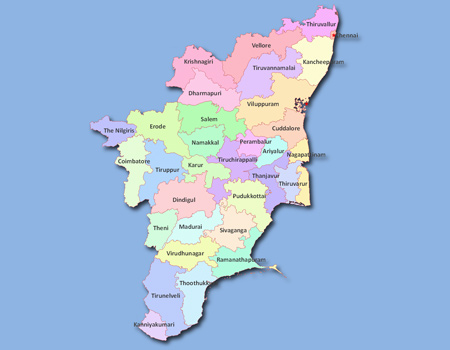
Tamil Nadu is a culturally rich and economically vibrant state located in the southernmost part of India. It is renowned for its historical heritage, diverse geography, robust agriculture, flourishing industries, well-developed irrigation and power sectors, comprehensive transport system, vibrant festivals, and a plethora of tourist attractions.
History and Geography
Tamil Nadu, with an area of about 130,058 sq km, is the tenth-largest Indian state. It is bounded by Andhra Pradesh and Karnataka to the north, Kerala to the west, the Bay of Bengal to the east, and the Indian Ocean to the south. The state's geography features the Western Ghats and Deccan Plateau on the west, the Eastern Ghats in the north, and extensive coastal plains along the Bay of Bengal. The Kaveri River delta forms the widest part of the eastern plains. The terrain includes fertile plains, hilly regions especially toward the west and north with the Nilgiri hills, and a long coastline stretching 1,076 km, the second-longest in India. Tamil Nadu’s history is marked by illustrious dynasties like the Cholas, Pandyas, Cheras, and Pallavas, who contributed to its rich temple architecture and cultural legacy. Tamil Nadu is also notable for ancient relics, historic buildings, and World Heritage Sites such as the Brihadeeswarar Temple in Thanjavur and the monuments at Mamallapuram.
Agriculture
Agriculture remains a crucial sector in Tamil Nadu, engaging about 60% of the population. The state's major crops include rice, sugarcane, cotton, millets, and various pulses. The fertile alluvial plains of the Kaveri delta are central to rice cultivation. Tamil Nadu is also the second-highest in India with regard to the number of agro and food processing units. Agriculture contributes around 12% to the state’s economy, supported by both traditional and modern farming practices. The state government has promoted agro-based industries, making Tamil Nadu a competitive player in food processing.
Industry
Tamil Nadu is one of India’s most industrialized states, with industry accounting for nearly one-third of its GDP. Key industries include textiles, automobiles and automobile components, IT and IT-enabled services, heavy commercial vehicles, cement, banking and financial services, pharmaceuticals, agro and food processing, leather tanning, and electronic hardware. The state has a strong industrial infrastructure and is a preferred destination for foreign direct investment. Chennai, Coimbatore, Tirupur, and Hosur are major industrial hubs.
Irrigation and Power
Irrigation in Tamil Nadu depends largely on river water, tanks, wells, and canals. The Kaveri River is the primary source of irrigation. Groundwater irrigation is significant but has been under stress due to over-extraction. About 51% of the cultivated area is irrigated; the rest depends on monsoon rains, which can be erratic. The state has built multiple dams that provide irrigation water, hydropower, drinking water, and flood control benefits. Tamil Nadu is also among the leading states in renewable energy production, particularly in wind and solar power, contributing significantly to its power sector.
Transport
Tamil Nadu has a well-developed transport infrastructure connecting urban and rural areas efficiently. The Tamil Nadu State Transport Corporation (TNSTC) is the largest government bus transport operator in India, covering vast intra and interstate routes as well as city routes. Chennai, the state capital, hosts a major international airport, well-connected rail networks, and highways facilitating trade and travel. The state’s ports, like Chennai and Tuticorin, are vital for maritime trade. Overall, the robust transport system supports both the economy and tourism.
Festivals
Tamil Nadu is famed for its vibrant and diverse festivals reflecting its cultural heritage. The harvest festival of Pongal, celebrated in January, is the most significant and widely observed. Other prominent festivals include Diwali, Tamil New Year (Puthandu), Karthigai Deepam, Thaipusam, and regional temple festivals like the Chithirai Festival in Madurai. These festivals showcase traditional music, dance, rituals, and cuisine, preserving the state’s rich folklore and religious diversity.
Tourist Centres
Tamil Nadu is a top tourist destination offering historical temples, hill stations, beaches, wildlife sanctuaries, and cultural experiences. Key attractions include:
- The Brihadeeswarar Temple in Thanjavur, a UNESCO World Heritage Site.
- Mamallapuram (Mahabalipuram), famous for its rock-cut temples and the Shore Temple.
- The Nilgiri Hills and hill stations like Ooty and Kodaikanal are known for scenic landscapes.
- Chennai, with its beaches, museums, and cultural venues.
- Wildlife sanctuaries such as Mudumalai and Guindy National Park.
- Historic cities like Madurai and Rameswaram, noted for their temples.
These sites reflect Tamil Nadu's architectural brilliance, natural beauty, and cultural depth.
This combination of rich history, diverse geography, strong agriculture, industrial growth, advanced irrigation and power systems, efficient transport, colorful festivals, and attractive tourist sites makes Tamil Nadu a unique and dynamic state in India.