Indian States and Union Territory - Rajasthan
Chief Minister: Shri Bhajan Lal Sharma
Governor/Administrator: Shri Haribhau Kisanrao Bagde
Area: 3,42,239 sq. km sq. km
Capital: Jaipur
Population: 6,86,21,012
Male Population: 80
Female Population: 52
Total Literacy(%): 67.06
Male Literacy(%): 80.51
Female Literacy(%): 52.66
Sex Ratio: 926
No of District: 33
Principal Languages: Hindi
Other Languages: Hindi and Rajasthani 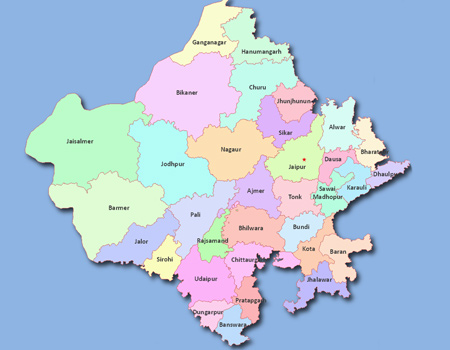
Rajasthan, located in northwestern India, is the largest state by area and rich in history, culture, and natural resources. This detailed article covers Rajasthan’s history and geography, agriculture, industry, irrigation and power, transport, festivals, and tourist centers.
History and Geography
Rajasthan's history dates back to ancient times, with human settlements traced back about 100,000 years. Before Indian independence, it was composed of several princely states and chiefships, which were later integrated into the Indian union after 1947. The state is known for the valor and chivalry of its warriors.
Geographically, Rajasthan covers about 342,239 square kilometers, constituting roughly 10.4% of India's area. It is dominated by the vast Thar Desert and the Aravalli Range, which runs southwest to northeast through the state for over 850 kilometers. Mount Abu is the only hill station located in the Aravalli hills. The state borders Pakistan’s Punjab and Sindh provinces and has diverse climatic zones ranging from arid desert to semi-arid and subtropical conditions.
Agriculture
Agriculture is the backbone of Rajasthan’s economy. The main crops include wheat, barley, pulses, sugarcane, and oilseeds. Cotton and tobacco are significant cash crops. The state is India's largest producer of rapeseed, bajra, guar seed, and spices such as fenugreek, coriander, cumin, fennel, and mustard. It ranks second in oilseed and spice production, also producing substantial quantities of soybean and coarse cereals. Due to arid conditions, irrigation heavily relies on wells, tanks, and canal systems like the Indira Gandhi Canal, which irrigates northwestern Rajasthan.
Industry
Rajasthan’s industries are diverse, dominated by mineral-based, agriculture-based, and textile sectors. It is a leading producer of polyester fiber and synthetic fabrics, with Bhilwara known as India’s largest producer of suiting fabrics and yarn. Jaipur is prominent in garment manufacturing, targeting exports. Other key industrial sectors include chemicals, engineering, automobile, electronics, and gemstones. Kota hosts chemical industries and education hubs. The state is also pre-eminent in quarrying, mining zinc, marble, sandstone, and crude oil production (notably from Barmer fields). Rajasthan is advancing in IT and IT-enabled services with IT parks in Jaipur, Jodhpur, Udaipur, and Kota.
Irrigation and Power
Rajasthan faces water scarcity, so irrigation is critical and mainly supported by traditional wells, tanks, and canal irrigation systems such as the Indira Gandhi Canal. Major hydroelectric power generation comes from dams like Rana Pratap Sagar Dam (172 MW), Jawahar Sagar Dam (99 MW), and Gandhi Sagar Dam, part of the Chambal Multipurpose Project, contributing over 386 MW in total. The state is also developing solar energy, with large solar parks like Bhadla Solar Park contributing significantly to renewable power.
Transport
Transport in Rajasthan is well-developed with road, rail, and air connectivity. The Rajasthan State Road Transport Corporation (RSRTC) operates approximately 5,000 buses from 56 depots connecting rural and urban regions, and also links to neighboring states and pilgrimage as well as tourist destinations. Railways connect major cities, and airports at Jaipur, Udaipur, Jodhpur, and other cities link the state nationally and internationally.
Festivals
Rajasthan is famed for vibrant and colorful festivals reflecting its rich cultural heritage. Major festivals include:
- Pushkar Camel Fair, the world’s largest camel and livestock fair.
- Teej, a women’s festival celebrating monsoon.
- Gangaur, celebrating the divine love of Shiva and Parvati.
- Marwar Festival, showcasing traditional desert music and dance.
These festivals attract tourists and celebrate Rajasthan’s traditions of music, dance, and folklore.
Tourist Centres
Tourism is a vital sector in Rajasthan. Famous tourist centers include:
- Jaipur (The Pink City): Known for forts, palaces, and markets.
- Udaipur: Famous for lakes, palaces, and luxury tourism.
- Jodhpur: The Blue City with Mehrangarh Fort.
- Jaisalmer: Known as the Golden City with stunning desert forts.
- Mount Abu: The only hill station.
- Pushkar: Famous for the sacred lake and camel fair.
- Ranthambore and Sariska National Parks: Wildlife tourism and tiger sanctuaries.
These sites highlight Rajasthan’s historical and natural heritage, drawing domestic and international tourists year-round.
Rajasthan stands as a unique blend of historic valor, cultural richness, natural beauty, and economic diversification with significant contributions to agriculture, industry, and renewable energy sectors. Its heritage festivals and iconic tourist destinations add to the vibrant identity of the state. This makes Rajasthan a vital and fascinating part of India’s landscape and economy.