Indian States and Union Territory - NCT of Delhi
Chief Minister: Smt. Rekha Gupta
Governor: Taranjit Singh Sandhu (Lieutenant Governor)
Area: 1,483 sq. km
Capital: Delhi
Population: 1,67,87,941
Male Population: 90
Female Population: 80
Total Literacy(%): 86.20
Male Literacy(%): 90.90
Female Literacy(%): 80.80
Sex Ratio: 868
No of District: 11
Principal Languages: Hindi, Punjabi, Urdu & English
Other Languages: Rajasthani, Garwali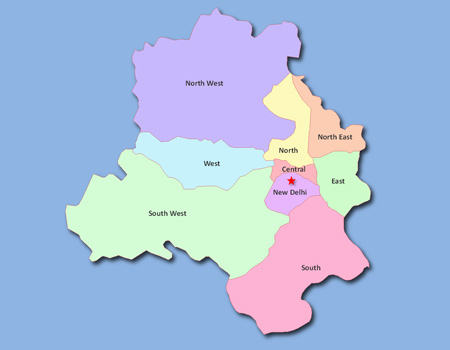
Delhi, India's National Capital Territory (NCT), is a vibrant metropolis blending ancient history with modern development. As the political and cultural heart of India, it houses the national government, numerous historical monuments, and a thriving urban economy.
History and Geography
Delhi's history dates back over 2,000 years, with its strategic location making it a focal point for various empires, including the Mauryas, Mughals, and British. The city has witnessed significant historical events, from the establishment of the Delhi Sultanate to the Indian Rebellion of 1857. Geographically, Delhi is situated in northern India, bordered by Haryana and Uttar Pradesh, covering an area of approximately 1,484 square kilometers. The Yamuna River flows through the city, contributing to its fertile plains. In 1911, the British ruler in India shifted their capital from Kolkata (Calcutta).
Agriculture
Agriculture in Delhi is limited due to urbanization, but the surrounding areas contribute to the city's food supply. The primary crops grown in the region include wheat, rice, and vegetables. Urban farming initiatives and community gardens have also emerged, promoting sustainable agriculture within the city limits.
Industry
Delhi boasts a diverse industrial sector, with key industries including information technology, telecommunications, manufacturing, and tourism. The city is home to numerous multinational corporations, startups, and small-scale industries. The Delhi-Mumbai Industrial Corridor (DMIC) further enhances the region's industrial growth by improving infrastructure and connectivity.
Irrigation and Power
Irrigation in Delhi primarily relies on the Yamuna River and groundwater sources. The city has implemented various water management strategies to address its growing water needs. Power supply in Delhi is robust, with multiple power plants and a well-developed grid ensuring consistent electricity for residential, commercial, and industrial use. Renewable energy initiatives, such as solar power installations, are also being promoted.
Transport
Delhi has an extensive transport network, including roads, railways, and airways. The Delhi Metro is a major mode of public transportation, connecting various parts of the city and reducing traffic congestion. The city is also served by Indira Gandhi International Airport, one of the busiest airports in India. Additionally, Delhi's road network includes national highways and expressways that facilitate regional connectivity.
Festivals
Delhi celebrates a multitude of festivals reflecting its cultural diversity. Major festivals include:
- Diwali: The Festival of Lights, celebrated with fireworks, decorations, and feasts.
- Holi: The Festival of Colors, marked by vibrant celebrations and water fights.
- Eid-ul-Fitr: Celebrated by the Muslim community with prayers and feasts after Ramadan.
- Christmas: Observed with church services, decorations, and gift exchanges.
- Republic Day: Marked by a grand parade showcasing India's cultural heritage and military strength.
- Independence Day: Celebrated with flag hoisting, cultural programs, and patriotic events.
- Ramlila: A traditional open-air drama performed annually, depicting the epic Ramayana.
These festivals highlight Delhi's rich cultural tapestry and foster communal harmony among its residents.
Tourist Centres
Delhi is home to numerous tourist attractions, including:
- Parliament House: The seat of the Indian Parliament and a symbol of democratic governance.
- Akshardham Temple: A spiritual and cultural complex showcasing Indian heritage and architecture.
- Red Fort: A UNESCO World Heritage Site and iconic symbol of India's history.
- Qutub Minar: The tallest brick minaret in the world, showcasing Indo-Islamic architecture.
- India Gate: A war memorial dedicated to Indian soldiers who died in World War I.
- Lotus Temple: A Bahá'í House of Worship known for its unique lotus-shaped architecture.
- Humayun's Tomb: A magnificent garden tomb and precursor to the Taj Mahal.
- Rajghat: A memorial site dedicated to Mahatma Gandhi.
- Purana Qila: An ancient fort and palace complex with historical significance.
- Bangla Sahib: A historic Sikh gurdwara in Delhi.
These sites attract millions of tourists annually, contributing significantly to Delhi's economy and cultural prominence.
In conclusion, Delhi stands as a dynamic metropolis that seamlessly integrates its rich historical legacy with modern advancements. Its diverse economy, robust infrastructure, and vibrant cultural scene make it a pivotal city in India.