Indian States and Union Territory - Nagaland
Chief Minister: Shri Neiphiu Rio
Governor: Shri Nand Kishore Yadav
Area: 16,579 sq. km
Capital: Kohima
Population: 19,80,602
Male Population: 83
Female Population: 76
Total Literacy(%): 80.11
Male Literacy(%): 83.29
Female Literacy(%): 76.69
Sex Ratio: 931
No of District: 11
Principal Languages: English
Other Languages: Angami, Ao, Chang, Konyak, Lotha, Sangtam, Sema and Chakhesang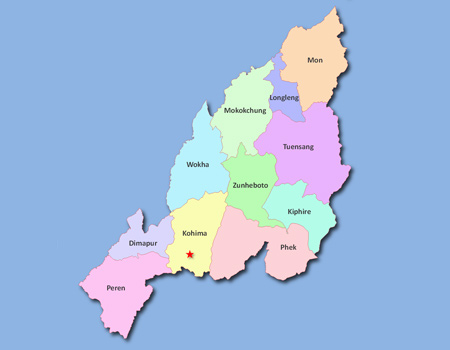
Nagaland is a unique and vibrant state in the northeastern region of India, known for its rich tribal legacy, diverse geography, and cultural festivals. The state presents an interesting blend of history, geography, agriculture, industry, power resources, and transport infrastructure, along with a colorful array of festivals and tourist destinations.
History and Geography
Nagaland, the 16th state of India formed in 1963, lies in the hilly terrain of northeast India, bordered by Arunachal Pradesh, Assam, Manipur, and Myanmar. Historically, it has a strong tribal heritage with various Naga tribes inhabiting the region. Its geographical landscape features the Naga Hills, Patkai Range, and Barail Range, with Mount Saramati (3,841 meters) as the highest peak, often called the "Crown of Nagaland." The state is marked by subtropical evergreen forests, valleys like Dzukou Valley, and rivers such as Dhansiri, Doyang, Dikhu, and Tizu, which support biodiversity and local livelihoods in this dissected hilly terrain.
Agriculture
Agriculture is the backbone of Nagaland's economy, engaging around 70% of its population. The farming system is predominantly traditional, including terrace and jhum (shifting) cultivation. Major crops include rice, maize, millets, pulses, oilseeds, sugarcane, potatoes, tobacco, and horticultural products such as pineapples, oranges, and cardamom. Remarkably, there are no landless peasants, reflecting widespread land ownership among the tribal communities.
Industry
While primarily agrarian, Nagaland has seen growing industrial activity, especially in agro-processing, handloom, and handicrafts. The state is rich in mineral resources such as coal, limestone, and petroleum, but large-scale mining remains limited. Handicrafts, including bamboo and cane works and traditional shawls, are important employment sectors. The government promotes agro-based industries, bamboo and wood-based industries, and tourism-related enterprises as future growth areas.
Irrigation and Power
Nagaland has significant water resources from its many rivers and springs, which are essential for drinking water and irrigation. Hydropower is a key resource; the Doyang Hydroelectric Project, with a 75 MW capacity, is a major contributor to the state's power supply. Smaller hydropower projects are also promoted, along with policies supporting renewable energy development. Efforts are underway to improve rural water supply under national schemes.
Transport
The transport system in Nagaland includes an extensive passenger bus service operated by Nagaland State Transport over more than 211 routes and 517 scheduled services. The department also coordinates state helicopter services and civil infrastructure development. Road connectivity is vital due to the hilly terrain, linking commercial hubs like Dimapur to other parts of the state. Inland water transport is emerging under government initiatives, supporting connectivity and trade.
Festivals
Nagaland is famously known as the "land of festivals" where every tribal community celebrates its own colorful festivals with traditional dances, music, and rituals. The Hornbill Festival, held annually in December, is the most prominent, showcasing Naga heritage and culture to visitors. Other important festivals include Moatsu, Sekrenyi, and Tuluni, all reflecting the rich tribal diversity and customs.
Tourist Centres
Tourism in Nagaland is centered on its natural beauty, culture, and heritage sites. Key destinations include:
- Dzukou Valley: Renowned for its scenic beauty and biodiversity.
- Mount Saramati: The highest peak, popular with trekkers.
- Mon District: Known for traditional Naga villages.
- The Hornbill Festival venue showcases cultural performances.
- Various wildlife sanctuaries and forests offering eco-tourism.
The state's unspoiled landscapes and ethnic culture attract over 80,000 annual tourists, contributing significantly to the local economy.
In conclusion, Nagaland presents a fascinating state with a rich historical background, abundant natural resources, a traditional agrarian economy, emerging industries, renewable energy potential, transport development, vibrant festivals, and unique tourist attractions, making it an important cultural and ecological jewel in India's northeast.