Indian States and Union Territory - Mizoram
Chief Minister: Shri PU Lalduhoma
Governor/Administrator: General (Dr.) Vijay Kumar Singh, PVSM, AVSM, YSM (Retd.)
Area: 21,081 sq. km sq. km
Capital: Aizawl
Population: 10,91,014
Male Population: 65
Female Population: 89
Total Literacy(%): 74.04
Male Literacy(%): 65.46
Female Literacy(%): 89.00
Sex Ratio: 975
No of District: 8
Principal Languages: English
Other Languages: Mizo and English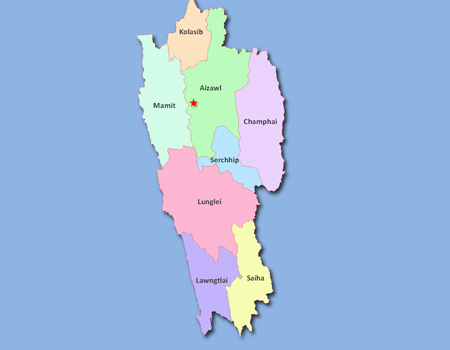
Mizoram, located in the northeastern part of India, is known as the "Land of the Hills," characterized by its rich cultural heritage, scenic geography, and vibrant traditions. The state borders Myanmar to the east and south, Bangladesh to the west, and the Indian states Assam, Manipur, and Tripura to the north and west, respectively. Its capital and largest city is Aizawl.
History and Geography
The history of Mizoram dates back to ancient times, with archaeological evidence suggesting human settlements as early as 600 BC, particularly in the Vangchhia region. Early inhabitants were Tibeto-Burman-speaking peoples migrating from present-day Myanmar, who formed organized chiefdoms and practiced traditional slash-and-burn (jhum) farming. Over time, these groups developed a distinct Indo-Lushai cultural identity. Geographically, about 90% of Mizoram is hilly terrain, part of the Arakan Mountain range, with ridges made of sandstone, limestone, and shale. The hills rise to approximately 7,000 feet (2,100 meters), and the terrain features narrow river valleys with major rivers like the Kaladan, Tlawng, and Sonai flowing through them.
Agriculture
Agriculture forms the backbone of Mizoram’s economy. Traditionally, jhum cultivation was prevalent, but there has been a gradual shift towards settled agriculture and horticulture to adapt to population pressure and conserve the environment. The government actively promotes settled farming, soil and water conservation techniques, and organic farming practices. Crops such as rice, maize, cotton, and vegetables dominate, along with horticulture crops like fruits, spices, and flowers, encouraged by state initiatives. This diversification has helped increase farmers’ incomes and improve food security.
Industry
Mizoram’s industrial sector is predominantly agro-based and forest-based, including small-scale industries related to sericulture (silk production), handloom, handicrafts, furniture manufacturing, oil refining, grain milling, and ginger processing. The government supports these industries through policies framed since 1989, aiming to boost food processing and commercial production. Despite these efforts, large-scale industrialization remains limited due to the state's terrain and infrastructure challenges.
Irrigation and Power
The state has significant hydropower potential estimated at around 4,500 MW, although its current installed power capacity is about 265 MW, sourced primarily from hydroelectric projects like the Tuirial (60 MW) and Serlui B (12 MW) plants. Apart from hydropower, thermal and renewable energy projects also contribute to the grid. Mizoram relies on power imports from neighboring states to meet demand, which is rising due to urbanization and development. Irrigation expansion is part of the agricultural modernization efforts, facilitating the move from jhum to settled farming.
Transport
Transport in Mizoram is challenging, given the hilly landscape. The road network connects all major towns, with National Highway 306 being a key route. Aizawl, the capital, has road connectivity and the Lengpui Airport linking Mizoram to other parts of India. Rail connectivity is limited but expanding with new projects underway to improve trade and access. Due to terrain constraints, transport infrastructure development remains a critical focus area for the state.
Festivals
Mizoram celebrates vibrant festivals reflecting its agricultural cycles and cultural values. The major festivals include Chapchar Kut (spring festival), Pawl Kut (post-harvest festival), and Mim Kut (autumn festival), all marked by traditional dances such as Khuallam and Chheih Lam, music, sports, and community feasts. Other important celebrations include the Thalfavang Kut in Hnahthial, which marks the end of crop weeding, and the Nunhlui Festival in Khawbung, which promotes Mizo cultural heritage. These festivals are occasions for displaying handicrafts, traditional attire, and enjoying folk games.
Tourist Centres
Mizoram’s tourist attractions are known for their natural beauty and cultural significance. Key sites include:
- Vantawng Falls near Thenzawl, the highest waterfall in Mizoram.
- Kawtchhuah Ropui, a megalithic site with about 200 stone monuments near Vangchhia Village.
- Mizo Hlakungpui Mual, a monument commemorating Mizo poets.
- Khawnglung Wildlife Sanctuary, offering rich biodiversity.
- Saikuti Hall in Aizawl, a cultural venue with a museum showcasing local art.
These destinations provide insight into the state’s heritage and scenic appeal, making Mizoram a unique blend of nature and culture.
In short, Mizoram is a state with a deep historical legacy, a predominantly agrarian economy adapting to modern practices, significant hydroelectric potential, vibrant festivals, and rich tourist attractions amid its picturesque hills and valleys. It continues to develop infrastructure to harness its natural resources and improve connectivity while preserving its unique cultural identity.