Indian States and Union Territory - Meghalaya
Chief Minister: Shri Conrad Kongkal Sangma
Governor/Administrator: Shri C H Vijayashankar
Area: 22,429 sq. km
Capital: Shillong
Population: 29,64,007
Male Population: 77
Female Population: 73
Total Literacy(%): 75.48
Male Literacy(%): 77.17
Female Literacy(%): 73.78
Sex Ratio: 986
No of District: 7
Principal Languages: English
Other Languages: Khasi, Garo and English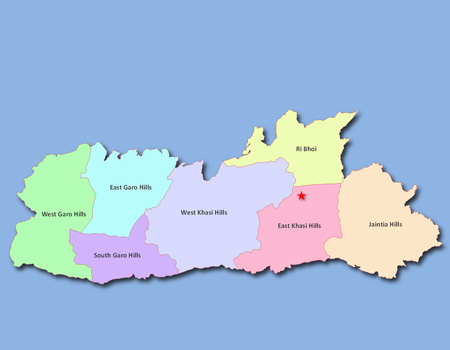
Meghalaya, known as "the abode of clouds," is a vibrant and picturesque state in northeastern India, celebrated for its dramatic landscapes, rich culture, and dynamic history. The following article covers all major aspects of Meghalaya, including its history and geography, agriculture, industry, irrigation and power, transport, festivals, and tourist centres, offering a unique and detailed perspective on this remarkable state.
History and Geography
Meghalaya attained full statehood on January 21, 1972, after being carved out from Assam’s United Khasi, Jaintia, and Garo hills districts, having earlier been an autonomous region since 1970. The historical trajectory of Meghalaya is marked by the colonial annexation of Khasi, Jaintia, and Garo realms by the British in the 19th century, and its eventual emergence as an independent state after movements for autonomy. Meghalaya is essentially a hilly state bounded on the north and east by Assam and on the south and west by Bangladesh. It features a central plateau, the Meghalaya plateau, with elevations ranging from 150 to 1961 metres, and boasts distinct hill divisions: Khasi Hills (central), Jaintia Hills (east), and Garo Hills (west). Shillong Peak, at 1961 metres, is the highest point in the state.
Agriculture
Close to 80% of Meghalaya’s population depends on agriculture for livelihoods, making it a predominantly agrarian economy. The state is renowned for its production of rice, maize, potatoes, pineapples, bananas, papayas, spices, and increasingly, millet and buckwheat, which suit its hilly terrain and variable rainfall. Traditional shifting agriculture, known locally as jhum, is still practiced, though modern methods are gradually being adopted. Despite the state's fertile land, only about 10% of its total area is under cultivation, with productivity remaining low due to limited mechanization and infrastructure. Recent initiatives involve farmer support through village-level and processing hubs dedicated to food processing, horticulture, and nutraceutical crops.
Industry
Meghalaya’s industrial sector is modest but growing, focused on agro-processing, commercial forestry, cement, and mineral extraction — especially limestone, coal, and uranium. The service sector includes real estate, insurance, and small-scale enterprises. The state has operational food processing hubs and initiatives centered around harnessing the rich horticultural output, with more than 13,500 farmers supported by processing hubs in recent years. Industrial and investment promotion schemes aim to encourage the processed food, spices, and honey industries.
Irrigation and Power
Because of its topography and plentiful rainfall, most agriculture in Meghalaya is rain-fed rather than irrigated. Recent development in irrigation aims to supplement rainfall and expand cultivated acreage. Power generation in Meghalaya is primarily hydroelectric, leveraging falls and rivers to provide energy. The Umiam Hydroelectric Project (since 1965) and other stations serve the state’s needs, with ongoing upgrades and grid enhancements increasing transformer capacity, transmission lines, and sub-stations. The state’s power policy prioritizes grid expansion, loss reduction, and reliable supply, and includes commissioning of large-scale projects for future growth.
Transport
Meghalaya is well-connected internally and regionally with a network of about 1,170 km of national highways and efficiently maintained state roads. Shillong, the capital, serves as the main logistical hub and gateway for tourists and goods. While the state has no railway network, road transport, commercial buses, taxis, and private vehicles form the backbone of travel. Major highways connect Meghalaya to cities in Assam and nearby Northeast states, and cross-border trade flows into Bangladesh through state checkpoints. Air connectivity is provided by Shillong Airport, linking to larger Indian cities.
Festivals
Meghalaya’s year-round festivals reflect its tribal and modern diversity. The internationally renowned Cherry Blossom Festival (2025 highlights include performances by global artists like Jason Derulo, The Script, Diplo, and Aqua) draws music, art, and cosplay enthusiasts to Shillong and attracts thousands of tourists. Other traditional festivals include Wangala (harvest festival of the Garos), Shad Suk Mynsiem (Khasi dance festival), Behdeinkhlam (Jaintia religious event), and Nongkrem Dance (Khasi thanksgiving celebration). These festivals are immersive, featuring costumes, rituals, music, and dance.
Tourist Centres
Meghalaya is a treasure trove of natural wonders and unique cultural attractions. Must-visit sites include:
- Shillong Peak: Highest and most panoramic viewpoint in the state.
- Sohra (Cherrapunji): Famous for world-record rainfall and enchanting monsoon valleys.
- Mawsynram: Home to living root bridges and lush green landscapes, especially during the monsoon.
- Mawsmai Caves: An adventurous trek through rain-carved underground marvels.
- Umiam Lake: A tranquil and scenic site for boating and picnics near Shillong.
- Living Root Bridges: Botanically unique, centuries-old bridges woven from tree roots over river gorges.
- Elephant Falls, Don Bosco Museum, Ranikor (angling), and Krang Suri Falls: Popular family-friendly destinations.
Meghalaya’s alluring blend of dramatic landscapes, vibrant festivals, and growing economic potential makes it one of India's premier destinations for travellers and a vital region for ongoing development and cultural preservation.