Indian States and Union Territory - Manipur
Chief Minister: President Rule
Governor: Shri Ajay Kumar Bhalla
Area: 22,327 sq. km
Capital:Imphal
Population: 27,21,756
Male Population: 86
Female Population: 73
Total Literacy(%): 79.85
Male Literacy(%): 86.49
Female Literacy(%): 73.17
Sex Ratio: 987
No of District: 9
Principal Languages: Manipuri
Other Languages: Manipuri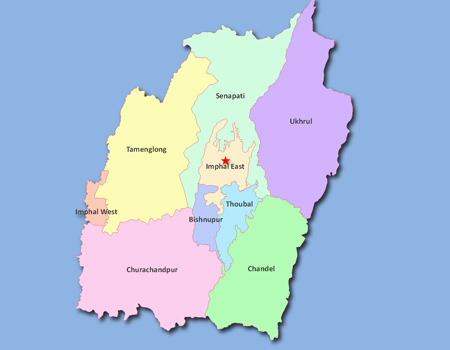
Manipur is one of the important and culturally rich states in northeastern India, known for its unique history, diverse geography, agriculture, industries, and cultural festivals. Below is a detailed article covering these various aspects of Manipur.
History and Geography
Manipur, often called the "Land of Gems," has a recorded history dating back to 33 A.D., marked by the reign of seventy-four kings until the last monarch, Maharaja Bodhachandra. It was an independent kingdom before being defeated by the British in 1891 and later integrated into India. Manipur's geographic location places it between 23°83'N to 25°68'N latitude and 93°03'E to 94°78'E longitude, covering an area of 22,327 square kilometers. It is bordered by Nagaland to the north, Mizoram to the south, Assam to the west, and shares an international boundary with Myanmar to the east. The terrain is distinctively divided into two ecological zones: rugged hills with narrow valleys and flat plains. The state has a unique oval-shaped valley, the Imphal Valley, surrounded by blue mountains, and significant water bodies like Loktak Lake, the largest freshwater lake in northeast India.
Agriculture
Manipur’s economy predominantly relies on agriculture, which remains the primary occupation. The state practices traditional jhum (shifting) cultivation and cultivates rice, the staple food, alongside maize, pulses, oilseeds, sugarcane, vegetables, and potatoes. The state's rich rainfall supports abundant forestry. Rubber and coffee plantations are also notable in Manipur. Despite the traditional focus, the state has been exploring modern irrigation techniques to improve productivity while maintaining sustainable water use practices. Traditional irrigation systems involve community participation and ecological wisdom, whereas modern techniques offer higher efficiency but need careful integration to sustain the environment and farmer involvement.
Industry
Manipur is relatively industrially underdeveloped. Its industrial sector is primarily composed of cottage industries, with handloom and handicrafts forming the backbone of local industry. The state has the highest number of handicraft units and artisans in the northeastern region of India, reflecting its rich cultural heritage in crafts. Small-scale industries also contribute to the economy, but larger industrial ventures remain limited due to the hilly terrain and infrastructural challenges.
Irrigation and Power
Irrigation in Manipur is traditionally practiced through ingenious local methods that have sustained agriculture over centuries, complemented increasingly by modern irrigation systems to boost efficiency and sustainability. Manipur also has significant hydroelectric potential due to its hilly terrain and abundant water resources. Hydropower projects are an essential part of the state's strategy for power generation, aiming to meet local demand and support economic growth.
Transport
Manipur's transport infrastructure includes roadways connecting the state internally and to other Indian states. Imphal Airport is the second largest in northeastern India, providing daily flights that enhance connectivity. The state serves as a strategic gateway to Southeast Asia through the border town of Moreh, facilitating trade with Myanmar and beyond. The connectivity improvement supports trade routes extending to East Asia and other regions, making Manipur a key conduit for international commerce.
Festivals
Manipur is renowned for its vibrant festivals reflecting its rich culture. Prominent festivals include the Manipur Sangai Festival, celebrating the state's flora and fauna and cultural heritage; the Shirui Lily Festival, held annually to showcase the rare Shirui lily; and the Barak Festival. Polo, which originated in Manipur, is celebrated through events such as the Manipur International Polo Tournament. Other festivals include the Pineapple and Orange Festivals, highlighting local produce, and the unique all-women’s Ema Keithel market festival, which is also a major cultural and tourist attraction.
Tourist Centres
Tourism in Manipur is flourishing with its natural beauty and cultural richness. Key attractions include:
- Loktak Lake: Famous for its floating phumdis (heterogeneous mass of vegetation).
- Keibul Lamjao National Park: The world’s only floating national park.
- Imphal Valley: Surrounded by scenic hills.
- Ema Keithel Market: The largest women's market in Asia.
- Ancient temples and palaces: Including Kangla Fort and historic temples.
Manipur's festivals themselves attract tourists globally, adding to the state’s appeal as a cultural hub.
In conclusion, Manipur's multifaceted character as a land steeped in history, blessed with geographic diversity, rich in agriculture and crafts, evolving its infrastructure and power resources, vibrant in cultural celebrations, and emerging as a significant tourist destination.