Indian States and Union Territory - Maharashtra
Chief Minister: Shri Devendra Fadnavis
Governor: Shri Jishnu Dev Varma
Area: 3,07,713 sq. km
Capital: Mumbai
Population: 11,23,72,972
Male Population: 89
Female Population: 75
Total Literacy(%): 82.91
Male Literacy(%): 89.82
Female Literacy(%): 75.48
Sex Ratio: 925
No of District: 35
Principal Languages: Marathi
Other Languages: Marathi 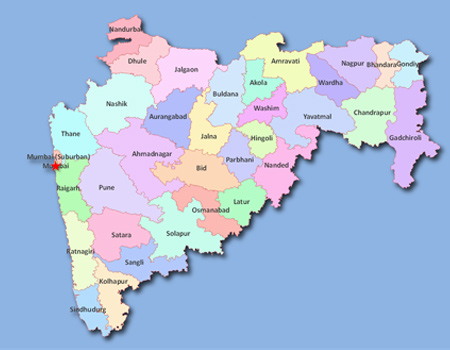
Maharashtra, a prominent state in western India, boasts a rich tapestry of history, diverse geography, robust agriculture, thriving industries, extensive irrigation and power projects, well-developed transport infrastructure, vibrant festivals, and captivating tourist destinations.
History and Geography
Maharashtra's roots trace back to ancient times, with its cultural and historical landscape shaped over millennia. Key historical phases include its rule under various dynasties and the Maratha Empire, cementing its identity as a cultural and political powerhouse. The state was officially established in 1960, carved from the Bombay State based on linguistic lines, predominantly Marathi-speaking.
Geographically, Maharashtra occupies a substantial portion of the Deccan Plateau. It features the western coastal plains along the Arabian Sea, uplands rising to the Sahyadri or Western Ghats, and plateaus inland characterized by step-like hills formed by lava outpourings known as traps. Its landscape includes major rivers such as the Godavari, the largest river in the state, flowing through Nashik, the Krishna flowing in the south, the Bhima (a Krishna tributary), and the Tapi in the northern region. These rivers carve broad valleys and interfluves, supporting agriculture and hydroelectric projects. The state has a 720 km long coastline with the Arabian Sea, and the regions vary from coastal plains to forested hills covering about 16.47% of the area.
Agriculture
Agriculture forms a vital part of Maharashtra's economy, with diverse crops grown across its varied agro-climatic zones. Key crops include sugarcane, cotton, soybeans, pulses, and millet. The state has also seen significant growth in horticulture, producing fruits like oranges and grapes. Maharashtra contributes over 12% to India's agriculture and allied sectors’ Gross Value Added. Its agriculture is supported by irrigation from rivers and reservoirs, alongside modern methods such as drip irrigation, which has been made mandatory for sugarcane cultivation over 3.05 hectares to improve water efficiency.
Industry
Maharashtra is an industrial leader in India, housing over 292 industrial areas and specialized sectoral parks, including those for food processing, textiles, IT, and floriculture. It accounts for about 13% of India's food processing industry, with over 2,700 registered food processing units contributing significantly to exports and employment. Mumbai, the state capital, is India’s financial hub, hosting key national institutions and a diverse economy spanning finance, IT, manufacturing, and entertainment.
Irrigation and Power
The state has an irrigation potential of approximately 4 million hectares. Maharashtra uses various water resources for irrigation, including canal irrigation, tube wells, and wells. Notable major irrigation projects include the Koyna Dam on the Koyna River, which is crucial for hydroelectric power generation, as well as the Upper and Lower Ghatghar dams. These multipurpose projects support agriculture, power generation, and drought management, particularly in the Marathwada region. The government promotes efficient water use to sustain agricultural productivity.
Transport
Maharashtra’s transport network is highly developed and multifaceted. The Maharashtra State Road Transport Corporation (MSRTC) operates extensive bus services connecting towns and villages across the state. Urban areas like Mumbai, Pune, Nagpur, and Navi Mumbai have metro rail systems, while Mumbai additionally has a monorail. The Mumbai and Pune Suburban Railways carry millions daily. The state also features two major ports—the Jawaharlal Nehru Port Trust (JNPT) and Mumbai Port—critical for maritime trade. Road, rail, air, and sea transport collectively support Maharashtra’s economic vibrancy.
Festivals
Maharashtra celebrates a variety of cultural festivals reflecting its rich traditions. Major festivals include:
- Gudi Padwa: The Marathi New Year celebrated with great enthusiasm.
- Ganesh Chaturthi: The state’s most famous festival honoring Lord Ganesha with elaborate idols and public processions.
- Diwali: The festival of lights, widely celebrated across Maharashtra.
- Holi: The vibrant festival of colors.
Other notable festivals include Makar Sankranti, Shri Krishna Janmashtmi with Dahi Handi events, Narali Purnima, and local cultural festivals at historic sites like the Ellora and Ajanta caves.
Tourist Centres
Maharashtra offers diverse tourist destinations ranging from historical sites to natural retreats:
- Mumbai: Known for the Gateway of India, Marine Drive, and the bustling city life.
- Aurangabad: Famous for the UNESCO World Heritage Ajanta and Ellora Caves.
- Mahabaleshwar and Panchgani: Hill stations renowned for lush greenery, waterfalls, and scenic views.
- Igatpuri: A destination for trekking, camping, and outdoor activities.
- Konkan Coast: Known for its beaches and coastal beauty.
The combination of historical forts, temples, hill stations, and festivals makes Maharashtra a vibrant tourism hub.
In conclusion, Maharashtra is a state where history blends with modernity, geography supports diverse agriculture and industry, and culture thrives through festivals and tourism, underpinned by strong infrastructure in irrigation, power, and transport. This dynamic state stands as a key pillar in India’s economy and cultural heritage.