Indian States and Union Territory - Madhya Pradesh
Chief Minister: Shri Mohan Yadav
Governor: Shri Mangubhai Chhaganbhai Patel
Area: 3,08,000 sq. km
Capital: Bhopal
Population: 7,25,97,565
Male Population: 80
Female Population: 60
Total Literacy(%): 70.06
Male Literacy(%): 80.05
Female Literacy(%): 60.00
Sex Ratio: 930
No of District: 50
Principal Languages: Hindi
Other Languages: Hindi 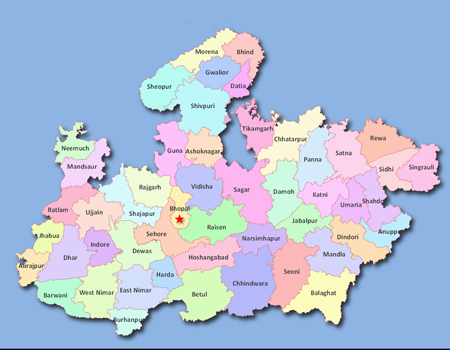
Madhya Pradesh, located in central India, is the country’s second-largest state by area and holds a significant position geographically, historically, agriculturally, industrially, and culturally. It is a key state for India's heartland, rich in historical legacies, natural resources, and cultural heritage.
History and Geography
Madhya Pradesh covers an area of about 308,000 square kilometers and is centrally placed, making it a pivotal region in India. Historically, the area was ruled by significant ancient kingdoms, including the Mauryan Empire under Emperor Ashoka, who governed from Ujjain. The Gupta Empire (300-500 A.D.) also included much of this region. The state has witnessed Muslim rulers' presence from the 11th century onward, adding layers to its diverse history. The terrain is characterized by vital river systems, including the Narmada, Tapi, Mahanadi, and Wainganga rivers, which flow through the state, supporting agriculture and settlements.
Agriculture
Agriculture is a major part of Madhya Pradesh’s economy, with diverse climatic zones supporting varied cropping patterns. The state ranks high in food grain production, just behind Uttar Pradesh and Punjab. It is the leading producer of pulses and oilseeds in India, contributing about 24-25% of the total national production. The state's agricultural growth has been substantial in recent decades, supported by a mix of favorable climate, soil diversity, and irrigation advancements.
Industry
Madhya Pradesh is rapidly growing as an industrial hub. Major cities like Indore and Mandideep are centers for textile and garment manufacturing, while Bhopal and Ujjain host pharmaceutical and multi-sector industries. The development of industrial corridors such as the Indore–Manmad and Malanpur–Gwalior zones is enhancing connectivity and industrial expansion. The state aims to become one of India’s top three manufacturing states by 2030, with ongoing efforts to align industries with sustainability and renewable energy goals.
Irrigation and Power
The state utilizes its river systems and has been pushing forward large-scale irrigation initiatives to support its farmers. One notable recent project is the distribution of solar-powered irrigation pumps to about 20 lakh farmers, reducing dependency on diesel and erratic electrical supply, and promoting sustainable farming practices. This renewable energy-driven approach aligns with Madhya Pradesh's vision of clean and green growth, providing consistent water access to boost productivity.
Transport
Madhya Pradesh is improving its transport infrastructure significantly. The Urban Transport Policy emphasizes enhancing public transportation with a fleet of buses to meet the population’s needs, deploying midi and minibuses according to city sizes. The policy also explores advanced transit options like the Mass Rapid Transit System (MRTS) and the Passenger Rapid Transit System (PRTS) in major cities. Efforts are made for route optimization and extending bus services beyond city limits by up to 25 km for better connectivity.
Festivals and Tourist Centres
Madhya Pradesh is culturally vibrant with numerous fairs and festivals that attract tourists. Major festivals include Shivratri celebrations in Khajuraho, Bhojpur, Pachmarhi, and Ujjain; Navratri and Dussehra in Jabalpur; Ramanavami in Chitrakoot and Orchha; and the Bhagoriya dance in Jhabua. The festivals, coupled with historical and natural tourist centers, make the state a favored destination. Tourist attractions span ancient temples, monuments, and natural beauty, including Khajuraho's temples, Pachmarhi hill station, Sanchi stupa, and wildlife sanctuaries.
In conclusion, Madhya Pradesh is a state with a rich historical past, diverse geography, strong agricultural base, growing industrial sector, progressive irrigation and power projects, improving transport infrastructure, and a thriving cultural tourism scene. It continues to play a crucial role in India’s economic and cultural fabric with a balanced focus on development and heritage preservation.