Indian States and Union Territory - Kerala
Chief Minister: Shri V. D. Satheesan
Governor: Shri Rajendra Vishwanath Arlekar
Area: 38,863 sq. km
Capital: Thiruvananthapuram
Population: 3,33,87,677
Male Population: 96
Female Population: 91
Total Literacy(%): 93.91
Male Literacy(%): 96.02
Female Literacy(%): 91.98
Sex Ratio: 1084
No of District: 14
Principal Languages: Malayalam
Other Languages: Malayalam 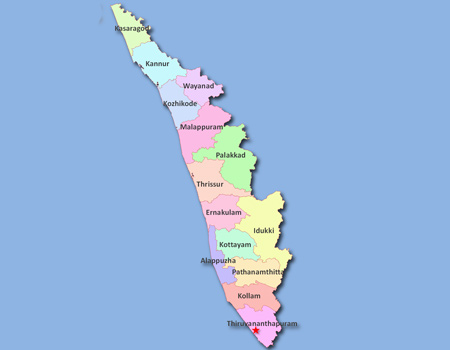
Kerala, a charming state on India's Malabar Coast, is a blend of rich history, diverse geography, and vibrant culture. It was formed on November 1, 1956, uniting Malayalam-speaking regions into one state. Kerala covers 38,863 km², bordered by Karnataka, Tamil Nadu, and the Arabian Sea, with Thiruvananthapuram as its capital. The landscape ranges from the cool, mountainous Western Ghats in the east to tropical coastal plains in the west, making it geographically distinct with fertile soil and scenic hills.
History and Geography
Kerala's ancient history is deeply influenced by its spice trade, attracting traders from Arabia, Europe, and China. A 14th-century flood reshaped its terrain and created natural harbors that enhanced spice commerce. The state is part of the Nilgiri Biosphere Reserve and has rich biodiversity. Geologically, it features pre-Cambrian and Pleistocene formations, with a tropical monsoon climate nurturing lush forests and plantations.
Agriculture
Agriculture remains central to Kerala's economy, focused on spices, cash crops, and food cultivation. The state grows rubber, coffee, tea, coconut, cashew, pepper, cardamom, and ginger commercially. Food crops include rice, pulses, sorghum, and tapioca, while commercial poultry farming is well developed. Kerala exports spices and food products with government programs supporting modern, climate-resilient agriculture.
Industry
Kerala's industries are diverse, including rubber processing, coir, handloom and power loom weaving, bamboo products, cashew processing, food processing, and tourism. The IT and electronics sectors have also grown rapidly, contributing to the state’s service-oriented economy. Mining and spice extraction remain important as well.
Irrigation and Power
Kerala uses an extensive network of reservoirs, canals, and hydroelectric projects to irrigate around 53,000 hectares. Notable projects include Idamalayar and Kallada irrigation schemes, which also provide hydroelectric power and drinking water. This efficient irrigation supports multiple cropping cycles, especially in unique agricultural systems like the Kole lands in Thrissur.
Transport
Kerala boasts an advanced transport network. The Kerala State Road Transport Corporation (KSRTC), established in 1965, runs over 6,200 buses connecting urban and rural areas. New eco-friendly electric buses and special services have been introduced recently. Rail and road networks link Kerala internally and connect to neighboring states. Air connectivity exists via several international airports.
Festivals
Kerala’s festivals are colorful and culturally rich, attracting tourists worldwide. Major festivals include:
- Onam (harvest festival celebrated statewide)
- Thrissur Pooram (famous temple festival)
- Vishu (Malayali New Year)
- Snake Boat Festival (spectacular boat races in Alappuzha)
- Theyyam (ritualistic dance in North Kerala)
- Pongala (women’s festival in Thiruvananthapuram)
These festivals reflect Kerala’s communal harmony and cultural vibrancy.
Tourist Centres
Kerala is known as "God's Own Country" for its picturesque backwaters, hill stations, and cultural richness. Key destinations include:
- Munnar and Wayanad (tea and spice plantations in the hills)
- Alappuzha and Kumarakom (backwater cruises and houseboats)
- Kochi (historic port city with colonial influences)
- Kovalam and Varkala (beaches)
- Periyar Wildlife Sanctuary (ecotourism and wildlife)
- Ecotourism, Ayurveda, and heritage tourism also contribute significantly to Kerala’s popularity.
This unique combination of geography, agriculture, industry, culture, and tourism makes Kerala a standout state in India, admired for its natural beauty and rich traditions.