Indian States and Union Territory - Karnataka
Chief Minister: S Siddharamaia
Governor: Shri Thaawarchand Gehlot
Area: 1,91,791 sq. km
Capital: Bengaluru
Population: 6,11,30,704
Male Population: 82
Female Population: 68
Total Literacy(%): 75.61
Male Literacy(%): 82.84
Female Literacy(%): 68.15
Sex Ratio: 968
No of District: 30
Principal Languages: Kannada
Other Languages: Kannada 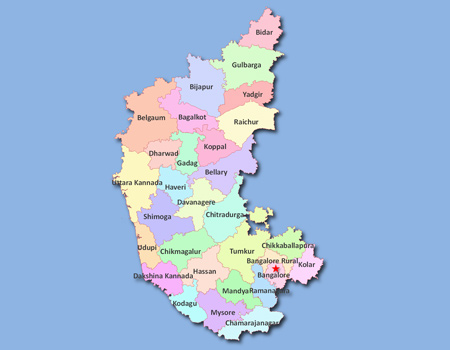
Karnataka, located in the southwestern region of India, is a state rich in history, diverse geography, agriculture, industry, and culture. Its evolving economy and vibrant festivals, coupled with significant tourism sites, make Karnataka a prominent state in India.
History and Geography
Karnataka was originally formed as Mysore State on 1 November 1956 and later renamed Karnataka. Geographically, it lies on the Deccan Plateau and borders the Arabian Sea to the west. Bounded by Goa, Maharashtra, Andhra Pradesh, Telangana, Tamil Nadu, and Kerala, Karnataka features four distinct regions: the coastal plain, the Western Ghats hill ranges, the Karnataka Plateau, and the black-soil tract to the northwest. The Western Ghats are a biodiversity hotspot, and the highest point, Mullayanagiri hill, stands at 1929 meters in the Chikkamagaluru district. The state is also marked by major rivers like the Krishna and the Sharavathi which flow westward, supporting the ecology and agriculture of the region.
Agriculture
Agriculture remains the backbone of Karnataka’s economy, engaging a majority of its population. The coastal plains are intensively cultivated, with rice as the principal food crop. The state is notable for growing millets such as ragi (finger millet), which supports local food security, alongside pulses. Commercial crops include sugarcane, cotton, and oilseeds. Karnataka also leads in organic and climate-resilient farming practices with trends in digital adoption for agriculture, enhancing productivity despite challenges like water scarcity and fragmented landholdings.
Industry
Karnataka’s industrial sector is diverse, with prominent contributions from information technology, biotechnology, and manufacturing. Bengaluru, often called the “Silicon Valley of India,” drives the IT sector, while the state also has established industries in textiles, aerospace, and education. It is rich in mineral resources feeding steel mills (Bhadravati) and heavy engineering (Bengaluru). Sericulture thrives in Mysuru and Bengaluru, producing a significant share of India’s mulberry silk. Other industries include cotton milling, sugar processing, electrical machinery, fertilizers, cement, and paper manufacturing.
Irrigation and Power
Karnataka possesses numerous dams and hydroelectric projects vital for irrigation and power production. Key hydroelectric projects include those on rivers like Tungabhadra, Krishna, and Ghataprabha, with capacities ranging from small (9 MW) to major projects (72 MW). These projects not only provide irrigation but also significantly contribute to the state's power supply, managed primarily by Karnataka Power Corporation Limited (KPCL). The state’s irrigation infrastructure supports its agricultural productivity, vital in a region with variable rainfall.
Transport
Karnataka has a well-developed transport infrastructure connecting its vast geography. National Highways such as NH 66 and NH 48 facilitate road connectivity from the coast to the interior and neighboring states. The Karnataka State Road Transport Corporation (KSRTC) operates extensive bus services linking towns and cities, along with city-specific transit services like the Bengaluru Metropolitan Transport Corporation (BMTC). Airports are located in Bengaluru, Belgavi, and Mangaluru, enhancing domestic and international connectivity. Auto-rickshaws and taxis are common for intra-city travel, and the government continues to improve transport networks.
Festivals
Karnataka is culturally vibrant with numerous festivals celebrated with traditional fervor. Major festivals include Mysuru Dasara, a grand 10-day event marked by processions and cultural programs in Mysore. The Hampi Festival celebrates the rich heritage of the UNESCO World Heritage site, featuring music and arts. Other notable festivals include Kambala (buffalo race), Vairamundi Festival in Melkote, highlighting Lord Vishnu worship, and Makar Sankranti, Ugadi (Kannada New Year). These festivals attract millions of devotees and tourists every year.
Tourist Centres
The state boasts several major tourist and heritage sites. Mysore Palace, with its stunning architecture, is a prime attraction. Hampi, an ancient Vijayanagara Empire capital, is a UNESCO World Heritage site known for its ruins and temples. Coorg and Chikkamagaluru are popular for their coffee plantations and scenic hills. Bandipur, Nagarhole, and Bannerghatta National Parks offer rich biodiversity and wildlife experiences. The Western Ghats provide trekking opportunities and natural beauty across places like Coorg, Kudremukh, and Agumbe.
In conclusion, Karnataka stands out as a state with a unique blend of historical heritage, geographical diversity, vibrant culture, dynamic agriculture, and a fast-growing industrial and technological landscape. Its irrigation projects and transport infrastructure bolster its economy, while its colorful festivals and tourist hotspots make it a vital destination in India.