Indian States and Union Territory - Gujarat
Chief Minister: Shri Bhupendra Patel
Governor: Shri Acharya Dev Vrat
Area: 1,96,024 sq. km
Capital: Gandhi Nagar
Population: 6,03,83,628
Male Population: 87
Female Population: 70
Total Literacy(%): 79.31
Male Literacy(%): 87.23
Female Literacy(%): 70.73
Sex Ratio: 918
No of District: 26
Principal Languages: Gujrati
Other Languages: Gujarati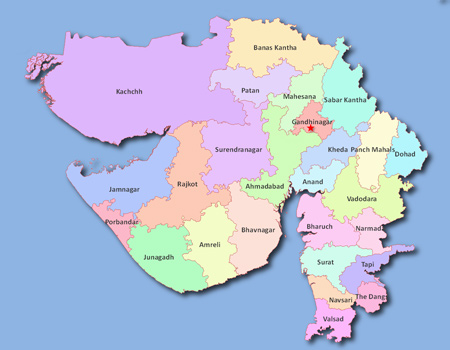
Gujarat, a western Indian state along the Arabian Sea coast, is a land of rich history, diverse geography, vibrant agriculture, dynamic industry, extensive irrigation and power systems, advanced transport networks, colorful festivals, and numerous tourist attractions.
History and Geography
Gujarat's history dates back to around 2000 B.C., with its ancient legacy influenced by various kingdoms including the Mauryas, Guptas, and Chalukyas. It is believed that Lord Krishna migrated to the west coast, establishing Dwarka, a significant historical site. The region saw prosperity under the Chalukyas despite invasions and later experienced diverse rule under Muslims, Marathas, and the British. The modern state of Gujarat was formed in May 1960 from the Bombay state.
Geographically, Gujarat stretches from the salt deserts of the Kachchh district to the arid Kathiawar Peninsula and fertile coastal plains. It features the Rann of Kachchh, vast salt marshes that flood seasonally. The state has diverse terrain including low hills, the Girnar Hills with its highest elevation of 3,665 feet, and river systems like the Narmada and Tapi that flow into the Gulf of Khambhat. Soils vary from poor crystalline to fertile basalt-derived lands in the southeastern part.
Agriculture
Despite 58% of the land being arid or semi-arid, Gujarat is India's largest producer of cotton, groundnuts, condiments, and spices. It accounted for over 42% of India's groundnut production in recent years and leads the world in castor, cumin, fennel seed, and psyllium husk production. The state has a growing dairy industry, ranking 5th in milk production nationally, with major contributions from cooperative milk societies, notably Amul Dairy, Asia’s largest milk processor. However, food grain productivity is moderate compared to other Indian states due to climatic and soil conditions.
Industry
Gujarat is India’s most industrialized state with a leading industrial output. It dominates in sectors like chemicals, petrochemicals, pharmaceuticals, dairy, cement, ceramics, gems and jewellery, textiles, and engineering goods. The state contributes around 30.7% of India's exports with significant port cargo handling, especially at Mundra Port, the largest in India by cargo volume. It is a pharmaceutical hub with 130 USFDA-certified drug manufacturing plants centralized in cities like Ahmedabad and Vadodara, underscoring its importance in drug production and export. Gujarat also has a robust electricity production capacity supporting its industries.
Irrigation and Power
Gujarat pioneered India's groundwater revolution with initiatives like the Jyotigram scheme, which rewired rural areas to separate agricultural and non-agricultural power supplies, ensuring 24/7 electricity for non-farm consumers and rationed but high-quality power to farmers. This system improved farm power efficiency, made utilities profitable, and helped sustainably manage groundwater resources. Despite reduced power hours for farmers, agriculture flourished with a growth rate of 9.5% annually between 2000 and 2014.
Transport
Gujarat boasts an extensive and efficient transport network encompassing road, rail, air, and maritime routes. The state has numerous professional road transportation companies providing comprehensive logistics services. Its strategic location with the longest coastline in India supports large port facilities handling substantial cargo volumes, facilitating export and import activities. This infrastructure underpins Gujarat’s economic growth and connectivity with national and global markets.
Festivals
Gujarat is known for its vibrant festivals reflecting its rich culture and traditions. Navratri is the most famous, celebrated with traditional dance forms like Garba and Dandiya. Other major festivals include Diwali, Uttarayan (the kite festival), Janmashtami, and the International Kite Festival in Gujarat. These festivals are marked by communal gatherings, elaborate rituals, folk music and dances, and colorful attire, embodying the joyous spirit of the state.
Tourist Centres
Gujarat offers diverse tourist attractions from historical sites, temples, and wildlife sanctuaries to natural wonders and industrial marvels. Key tourist destinations include:
- The Rann of Kachchh, famous for its salt desert and white landscapes.
- Gir National Park, home to the Asiatic lions.
- The ancient city of Dwarka, linked to Lord Krishna.
- Somnath Temple, an important pilgrimage site.
- Saputara, a charming hill station.
- The Sun Temple at Modhera and the historic Palitana Jain temples.
- Coastal beaches and vibrant cities like Ahmedabad and Vadodara with rich heritage and modern amenities.
Gujarat thus stands out as a state blending ancient heritage and modern growth, with its strong agriculture and industrial base supported by strategic infrastructure, making it a crucial contributor to India’s economy and culture.