Indian States and Union Territory - Bihar
Chief Minister: Shri Nitish Kumar
Governor: Lt. General (Retired) Syed Ata Hasnain
Area: 94,163 sq. km sq. km
Capital: Patna
Population: 10,40,99,452
Male Population: 73
Female Population: 53
Total Literacy(%): 63.82
Male Literacy(%): 73.39
Female Literacy(%): 53.33
Sex Ratio: 916
No of District: 38
Principal Languages: Hindi
Other Languages: Hindi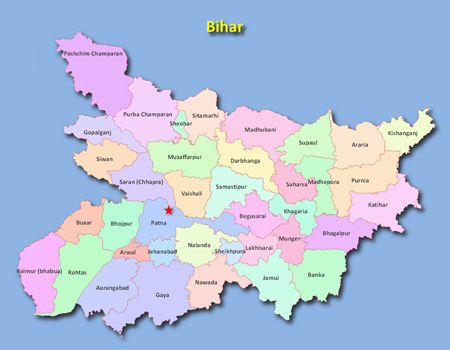
Bihar is a culturally rich and historically significant state in eastern India, characterized by distinct geographical features, vibrant agriculture, evolving industry, developing infrastructure, diverse festivals, and notable tourist centers.
History and Geography
Bihar covers an area of approximately 94,163 km² and is landlocked, sharing borders with Nepal to the north, West Bengal to the east, Uttar Pradesh to the west, and Jharkhand to the south. Geographically, it is divided into three main parts: the Southern Plateau, the Shivalik Region in the north, and the vast Gangetic Plain, bisected by the Ganges River into North and South Bihar. The state has fertile plains but also includes small hills such as the Rajgir hills and the Kaimur Range. Bihar lies in the subtropical humid climate zone, experiencing hot summers, cold winters, and significant rainfall between May and September. Historically, Bihar was a major center of power and learning in ancient India, home to Magadha, the Mauryan and Gupta empires, and important educational institutions like Nalanda and Vikramshila universities, considered some of the oldest international universities.
Agriculture
Agriculture remains the backbone of Bihar’s economy, employing over 80% of the population. It ranks as the fourth-largest producer of vegetables and the eighth-largest producer of fruits in India. Major agricultural products include rice, wheat, sugarcane, litchi, guava, mango, pineapple, and various vegetables. The fertile Gangetic Plain and favorable climate support diverse cropping, though challenges like floods and droughts affect productivity in different regions. Recent advancements focus on integrating science and technology, such as precision farming, water management, and biotechnological interventions to enhance sustainability and productivity. Programs like the Jaivik Corridor Scheme and Makhana Development aim to empower farmers and boost agricultural innovation.
Industry
Industrial development in Bihar is growing, supported by the Bihar Industrial Area Development Authority. The region hosts major industrial activities in cities like Begusarai, Hajipur, Muzaffarpur, Munger, and Patna. Notable industries include the Barauni Refinery, NTPC power plants, fertilizer production, dairy, and food processing units. Hajipur has also gained recognition for exporting designer shoes and other products to Europe and Russia. In recent years, efforts to improve IT infrastructure and establish software parks in Patna, Darbhanga, and Bhagalpur have further diversified the industrial landscape. The state seeks to attract large industrial houses and promote small industries for economic growth.
Irrigation and Power
Irrigation and power are crucial for Bihar's predominantly agricultural economy. The availability of electricity has transformed irrigation practices, enabling farmers to use electric pumps instead of relying solely on monsoon rains or diesel generators. This has led to increased productivity and the cultivation of multiple crops per year. Biomass power plants have also contributed by providing affordable irrigation power and creating bio-energy crops, enhancing farmers' incomes. The phrase "Paani hai to kisaan hai, Roshni hai to roji hai" (Where there is water, there is farming; where there is electricity, there is livelihood) aptly captures the link between power availability and agricultural prosperity in rural Bihar.
Transport
Bihar’s transport infrastructure includes a well-established road network operated by the Bihar State Road Transport Corporation (BSRTC), which provides extensive bus services connecting both urban and rural areas. The BSRTC also runs city buses in Patna and operates numerous routes within Bihar and to neighboring states, enhancing regional connectivity. The state is making strides in improving transport to support economic development and facilitate easier travel for residents and tourists.
Festivals and Tourist Centres
Bihar celebrates a rich tapestry of festivals reflecting its cultural heritage. Major festivals include the Rajgir Mahotsav, a vibrant event featuring classical and folk music, dance, handicrafts, and local cuisine held in the ancient city of Rajgir. Other notable festivals organized by the government include the Surya Festival in Aurangabad, Koshi Festival in Saharsa, Vaishali Festival, and Mithila Lok Festival in Darbhanga, among others, showcasing regional traditions and arts. Tourist attractions encompass historic and religious sites such as Nalanda, Rajgir, Bodh Gaya—where Buddha attained enlightenment, and Vaishali. These sites draw visitors interested in history, spirituality, and culture.
This combination of rich historical heritage, fertile geography, vibrant agriculture, budding industrial sector, improving infrastructure, and dynamic cultural life makes Bihar a unique and significant state in India.