Indian States and Union Territory - Assam
Chief Minister: Shri Himanta Biswa Sarma
Governor: Shri Lakshman Prasad Acharya
Area: 78,438 sq. km
Capital: Dispur
Population: 3,12,05,576
Male Population: 91
Female Population: 97
Total Literacy(%): 85.00
Male Literacy(%): 91.00
Female Literacy(%): 97.00
Sex Ratio: 954
No of District: 38
Principal Languages: Assamese
Other Languages: Assamese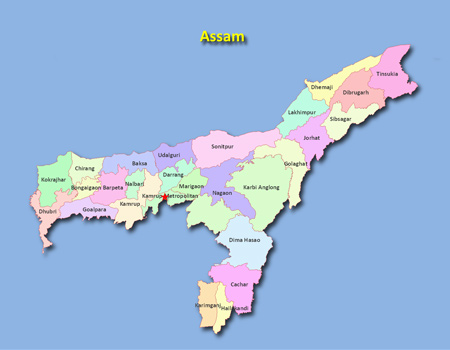
Assam, a vibrant state in the northeast of India, is renowned for its unique cultural legacy, rich biodiversity, and key economic contributions. It lies south of the eastern Himalayas, predominantly along the Brahmaputra and Barak river valleys, serving as a strategic and cultural bridge between India and Southeast Asia.
History and Geography
The history of Assam is traced through four major eras. The ancient era began as early as the 4th century with the rise of the Kamarupa Kingdom, first mentioned in Samudragupta's inscriptions. Medieval Assam saw an influx of external influence with attacks from the Bengal Sultanate after the fragmentation of Kamarupa, leading to the establishment of smaller kingdoms. The colonial era commenced after British annexation via the Treaty of Yandaboo in 1826. Post-1947 independence marks the state’s modern evolution.
Geographically, Assam integrates three of India's critical physiographic divisions: the Northern Himalayas, the Brahmaputra plains, and the Deccan Plateau outliers like Karbi Anglong. The region is dominated by the mighty Brahmaputra River, whose broad valley forms the state's fertile heartland. Its towns, like Guwahati and Dibrugarh, are pivotal urban and commercial centers.
Agriculture
Agriculture is the backbone of Assam’s economy. The state is world-famous for its robust Assam tea, accounting for over half of India’s tea output. Rice is the staple crop, with innovative schemes like the Agriculture Infrastructure Fund and Assam Agribusiness and Rural Transformation Project (APART) supporting modernization. The state is also a leader in organic farming, Muga silk production, and fisheries, benefiting from various national schemes such as PM-KISAN, Soil Health Card Scheme, and Kisan Credit Card, all operational and influential into 2025.
Industry
Assam stands as one of India’s mineral and energy powerhouses. It’s called the “Oil Hub of India,” home to Digboi, Asia’s first oil refinery, and produces a significant portion of the country’s crude oil and gas. Petrochemical complexes, handlooms (especially for Gamosa and Eri/Muga silk), and cottage industries are major employers. The state actively manufactures and exports handicrafts, bamboo products, and other traditional goods.
Irrigation and Power
The Brahmaputra’s might is both a boon for irrigation and a challenge due to frequent flooding. Irrigation strategies here focus on supplementing major crops, but extensive floodplain management is vital. Assam is rich in petroleum and natural gas resources, yet rural regions still face power shortages. Hydroelectric and solar projects are gradually expanding, modernizing the grid, and boosting rural electrification.
Transport
Assam’s transport infrastructure is crucial for both domestic integration and international trade, acting as a corridor for the northeast and neighboring countries. The road network is growing, but needs to be improved in the hill districts. Railways connect major centres, while the Brahmaputra National Waterway offers untapped potential for low-cost cargo movement. Guwahati serves as an emerging air travel hub for the entire northeast.
Festivals
Assam is celebrated for its array of traditional festivals:
- Bihu (Rongali, Kangali, Bhogali): The most important, marking agricultural cycles.
- Ambubachi Festival: Held at Kamakhya Temple, celebrating fertility and spirituality.
- Majuli Festival: Unites communities on the world’s largest river island with cultural showcases.
- Tea Festival, Dehing Patkai Festival, Ras Lila: These highlight ethnic diversity and the unique cultural tapestry of Assam.
Tourist Centres
Tourism flourishes thanks to Assam's natural wonders and heritage:
- Kaziranga National Park: A UNESCO World Heritage Site, home to the one-horned rhinoceros.
- Manas National Park: Another UNESCO site noted for its biodiversity.
- Majuli Island: The world’s largest river island, famous for Vaishnavite culture.
- Sivasagar, Tezpur, Hajo: These towns feature archaeological relics, temples, and monasteries.
- Tea Estates: Offering scenic beauty and a taste of colonial heritage.
Assam, therefore, is a region where lush landscapes, rich traditions, and industrious people come together, making it peerless in India’s tapestry.