Indian States and Union Territory - Arunachal Pradesh
Chief Minister: Mr. Pema Khandu
Governor: Lt. General Kaiwalya Trivikram Parnaik, PVSM, UYSM, YSM (Retired)
Area: 83,743 sq. km sq. km
Capital: Itanagar
Population: 13,82,611
Male Population: 73
Female Population: 59
Total Literacy(%): 66.95
Male Literacy(%): 73.69
Female Literacy(%): 59.57
Sex Ratio: 920
No of District: 25
Principal Languages: English
Other Languages: Monpa, Miji, Aka, Sherdukpen, Nyishi, Apatani, Tagin, Hill Miri, Adi, Digaru-Mismi, Idu-Mishmi, Khamti, Miju-Mishmi, Nocte, Tangsa, and Wancho.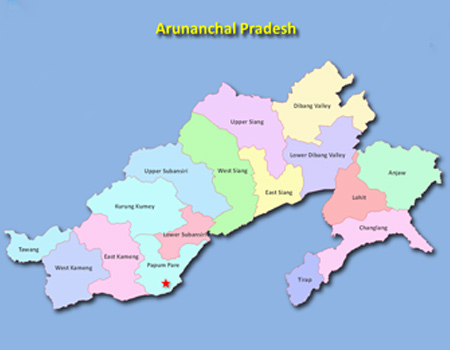
Arunachal Pradesh is a vibrant state in Northeast India known for its diverse geography, rich culture, and abundant natural resources. Here is a detailed article covering its history, geography, agriculture, industry, irrigation and power, transport, festivals, and tourist centers.
History and Geography
Arunachal Pradesh, often called the "Land of the Dawn-Lit Mountains," was originally known as the North-East Frontier Agency (NEFA) until 1972, when it became a union territory. It attained full statehood on February 20, 1987, with Itanagar as its capital. Geographically, it spans 83,743 km², making it the largest state in Northeast India. Situated in the foothills of the Himalayas, the state shares borders with Bhutan, Tibet (China), and Myanmar. Its terrain is predominantly hilly and mountainous, with elevations ranging from under 300 meters to peaks above 7,000 meters like Kangto (7,089m) and Nyegyi Kansang (7,047m). The region is heavily forested (around 80%) and crisscrossed by major rivers like Kameng, Subansiri, Siang, Dibang, and Lohit, which drain into the Brahmaputra basin. The diverse topography includes valleys, intermontane plateaus, and the Patkai hills, forming natural boundaries with Myanmar. The state's strategic location and varied landscape contribute to its ecological and cultural richness.
Agriculture
Agriculture is the backbone of Arunachal Pradesh's economy, supporting over 60% of the population. The traditional method of "jhum" or shifting cultivation has been practiced for decades. Key crops include rice, maize, millet, potato, ginger, mustard, and off-season vegetables. The state also produces a variety of horticultural crops, such as large cardamom, pineapple, apple, orange, lemon, litchi, papaya, banana, and several nuts like walnuts and almonds. Alongside food crops, cash crops such as sugarcane and potatoes are gaining prominence. The state is home to more than 500 indigenous medicinal and aromatic plant species, emphasizing sustainable and diverse agricultural practices. Some endemic vegetables like sweet potato, brinjal, chillies, pumpkin, cucumber, and local cowpea are cultivated as well.
Industry
The industrial sector in Arunachal Pradesh is still developing but holds great promise due to abundant natural resources. Major industries include weaving, arts and crafts, power generation, horticulture, and bamboo and cane products. The government promotes industrial undertakings in cooperative and private sectors, supporting businesses based on local raw materials, non-timber forest produce, textiles, handicrafts, and electronic-based industries. Industrial incentives include transport subsidies, insurance schemes, capital investment subsidies, and interest subsidies. The state also encourages medical and educational service industries. Tourism is arguably the most prominent industry, with many opportunities to expand due to the state's cultural and natural amenities.
Irrigation and Power
Arunachal Pradesh boasts the largest hydroelectric power potential in India due to its mountainous terrain and abundant water resources. Hydropower is the state's foremost renewable energy resource, with an assessed potential of over 58,000 MW. However, only about 1% of this potential has been harnessed so far. Major river basins such as Tawang Chu, Kameng, Dikrong, Subansiri, Siang, Dibang, Lohit, and Tirap offer numerous sites for hydropower projects. Several projects are slated for development but face delays due to regulatory and environmental clearances. Harnessing hydroelectric power is seen as a key path toward inclusive economic development for Arunachal Pradesh and India at large.
Transport
Arunachal Pradesh's transport system is improving, but is challenged by difficult terrains. The Arunachal Pradesh State Transport Services (APSTS) operates bus routes connecting key towns within the state and to nearby major cities like Dibrugarh and Tinsukia in Assam. These services facilitate daytime and night travel across strategic routes. Connectivity by road and air is gradually increasing, with efforts underway to improve infrastructure to promote tourism, trade, and accessibility in this remote region.
Festivals
The state's festivals reflect its rich indigenous tribal heritage. Major festivals celebrated with enthusiasm include Losar (Tibetan New Year), Solung and Etor (Adi tribe festivals), Dree (Apatani tribe festival), and Mopin (Galo tribe festival). These occasions feature traditional dances, songs, rituals, and community feasts, strengthening social bonds and showcasing Arunachal's cultural diversity.
Tourist Centres
Arunachal Pradesh offers stunning natural beauty and cultural richness attracting tourists year-round. Key tourist centers include:
- Tawang: Known for the Tawang Monastery (second largest monastery in the world), pristine landscapes, and Buddhist culture.
- Ziro Valley: Famous for scenic beauty and the Apatani tribal culture.
- Namdapha National Park: A biodiversity hotspot with rare flora and fauna.
- Pasighat: The oldest town and gateway to the Siang River.
- Sela Pass: A high-altitude mountain pass offering breathtaking views.
- Bomdila: A hill station with monasteries and craft markets.
These centers provide opportunities for trekking, wildlife viewing, cultural tourism, and eco-tourism.
In summary, Arunachal Pradesh is a land of remarkable natural wealth and cultural heritage. Its history as a frontier region, mountainous geography, agrarian economy, hydropower potential, evolving industry, improving transport, vibrant festivals, and scenic tourist spots combine to make it a unique and important part of India's Northeast.
Frequently Asked Questions (FAQs)
Q. What is the best time to visit Arunachal Pradesh?
ANS: The best time to visit Arunachal Pradesh is from October to April when the weather is pleasant and most areas are accessible. October to November offers post-monsoon freshness, while March to April features blooming rhododendrons in higher elevations. However, if you want to visit Tawang and experience snowfall, December to February is ideal, though roads may be challenging. The monsoon season (May-September) brings heavy rainfall that can disrupt travel plans and make roads impassable.
Q. Do I need special permits to visit Arunachal Pradesh?
ANS: Yes, special permits are required for visiting Arunachal Pradesh. Indian citizens need an Inner Line Permit (ILP), which can be obtained online or from designated offices in Guwahati, Kolkata, Delhi, and other major cities. The permit is usually valid for 15 days and can be extended. Foreign nationals require a Protected Area Permit (PAP) and must travel in groups of at least two people with a registered tour operator. These regulations exist due to the state's strategic border location with China.
Q. What are the major languages spoken in Arunachal Pradesh?
ANS: Arunachal Pradesh is linguistically diverse, with over 50 distinct dialects and languages spoken across its 26 major tribes. Hindi serves as the lingua franca and is widely understood, while English is used for official purposes and education. Tribal languages belong to different language families—Tibeto-Burman and Tani being predominant. Assamese is also spoken in some areas. This linguistic diversity reflects the state's rich cultural mosaic, though it also poses challenges for communication and administration.
Q. What is the main occupation of people in Arunachal Pradesh?
ANS: Agriculture remains the primary occupation for approximately 70% of Arunachal Pradesh's population. Most farming is subsistence-level, with rice being the principal crop. Shifting cultivation (jhum) is still practiced widely, though settled agriculture is being encouraged. Beyond farming, people engage in horticulture, animal husbandry, and fishing. Traditional occupations include handicrafts, bamboo work, and weaving. Government employment is also significant in the state economy. Tourism is emerging as an important sector, providing opportunities for guides, homestays, and related services.
Q. Why is Arunachal Pradesh called the "Land of the Rising Sun"?
ANS: Arunachal Pradesh earned this poetic name because it's India's easternmost state, where the sun rises first in the country. The name "Arunachal" itself means "Land of the Dawn-Lit Mountains" in Sanskrit. The easternmost point, Dong village in Anjaw district, witnesses sunrise much earlier than the rest of India—sometimes as early as 4:00 AM during summer. This geographical position makes it symbolically significant as the place where India greets each new day first, adding to its mystique and appeal.


