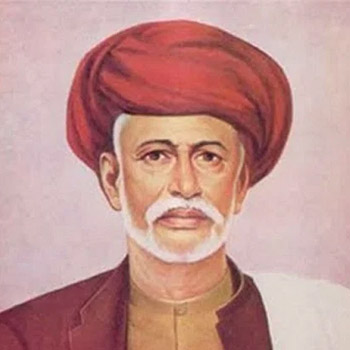
Dadabhai Naoroji
Dadabhai Naoroji stands as one of the most revered pioneers of Indian nationalism and economic thought against British colonialism. Born on September 4, 1825, in Bombay into a modest Parsi family, Naoroji's life's work crucially shaped the early nationalist movement and laid foundational economic critiques of British imperialism in India. He was known as the "Grand Old Man of India" for his tireless dedication to the cause of Indian self-rule and justice.
Early Life and Education
Naoroji received a diverse education blending traditional Indian and Western learning - initially studying at a pathshala before joining an English-medium school run by the Bombay Native Education Society. He went on to excel academically at Elphinstone College, Bombay, where he later became the first Indian full professor, teaching mathematics and natural philosophy. His broad intellectual background included chemistry, history, and political economy, fields in which he became deeply engaged, especially focusing on India's endemic poverty and economic challenges under colonial rule.
Political and Nationalist Contributions
Naoroji was a founding member of the Indian National Congress (INC), a crucial political platform that spearheaded India's freedom struggle. He served as the Congress president three times (1886, 1893, and 1906), during which the INC advanced resolutions on self-governance (Swaraj), boycotts, Swadeshi (indigenous industry promotion), and national education - key early demands setting the direction for Indian resistance. Notably, in 1906 during his presidency, the Congress adopted the explicit demand for Swaraj, signaling a clear political objective for self-rule.
The Drain of Wealth Theory
Naoroji's most distinguished contribution lies in the formulation of the "Drain of Wealth" theory. Through rigorous economic analysis, he demonstrated how British colonial policies systematically siphoned Indian resources - tax revenue, salaries, and business profits - away from India to Britain. This drain caused widespread impoverishment and economic stagnation in India. He articulated these ideas comprehensively in his seminal book, Poverty and Un-British Rule in India (1901). This work provided a scholarly foundation to expose how British rule economically debilitated India and helped galvanize nationalist critique and agitation.
Role in British Politics
In 1892, Naoroji became the first Indian elected to the British Parliament as a Liberal Party MP, representing Finsbury Central until 1895. In this unprecedented position, he acted as a vital bridge between India and Britain, tirelessly advocating for Indian self-governance and economic reforms at the heart of the British Empire. He spoke on issues of imperial policy, Indian poverty, and the urgent need for political representation, bringing Indian grievances into the British political discourse.
Social Reform and Intellectual Legacy
Beyond politics and economics, Naoroji was a committed social reformer and writer. He edited newspapers and magazines such as Rast Goftar and Dharma Marg Darshak, through which he criticized unjust British policies and highlighted social issues like peasant hardships. His writings educated both Indians and the British about the colonial exploitation India faced. He also inspired future leaders like Mahatma Gandhi and Jawaharlal Nehru, who considered his economic and political thoughts vital in shaping their strategies toward Indian freedom.
Lasting Impact and Recognition
Dadabhai Naoroji’s life and work laid the intellectual groundwork for Indian nationalism and anti-colonial economic critiques. His “Drain Theory” remains a landmark in the history of colonial economic analysis. He is revered as a pioneer of the nationalist movement and a symbol of Indian self-respect and justice. His legacy continues to inspire India’s freedom fighters and economic thinkers to this day. He is honored both in India and abroad, reflecting his role as an early advocate of Indian self-rule and dignity within the global political arena.
Dadabhai Naoroji’s unique combination of scholarly rigor, political activism, and social reform positioned him as a towering figure in India’s struggle against colonial subjugation - truly the “Grand Old Man of India” whose contributions resonate deeply in India’s history of independence.