A Climate Phenomenon That Reshapes the World
Every few years, the Pacific Ocean quietly engineers one of the most consequential weather events on the planet. No hurricane, no monsoon, no seasonal storm cycle rivals the sheer geographic reach of El Niño — a climatic force capable of triggering droughts on one continent while flooding another, collapsing fisheries while igniting wildfires, and reshaping the economic fortunes of billions of people in a matter of months.
Understanding El Niño is not merely a scientific curiosity. It is essential knowledge for a world increasingly vulnerable to climate extremes.
What is El Niño?
El Niño — Spanish for "The Little Boy," a reference to the Christ child, as the phenomenon was historically noticed around Christmas by Peruvian fishermen — is a periodic warming of sea surface temperatures in the central and eastern tropical Pacific Ocean. Under normal conditions, strong trade winds blow westward across the Pacific, pushing warm surface water toward Asia and Australia. This allows cooler, nutrient-rich water to upwell along the South American coast, sustaining one of the world's richest fishing zones.
During an El Niño event, those trade winds weaken or even reverse. Warm water sloshes back eastward, blanketing the central and eastern Pacific with unusually high sea surface temperatures — often 2 to 4°C above average, and sometimes more. This seemingly modest shift in ocean temperature sets off a cascading chain of atmospheric disturbances that ripple across the entire globe.
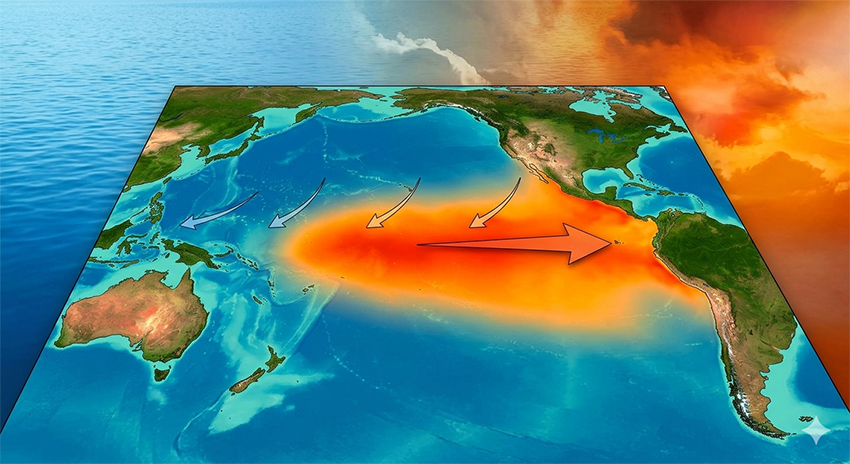
El Niño events typically develop between April and June, peak during December to February, and last roughly 9 to 12 months, though some events persist for two years or longer. They occur irregularly, roughly every 2 to 7 years, and vary widely in intensity — from mild fluctuations barely noticed beyond coastal South America to powerful super events that reorder global weather patterns.
The Science Behind the Disruption
The connection between ocean warming and atmospheric chaos lies in the way heat and moisture move between the sea and the sky. Warm ocean water causes overlying air to rise, fueling deep convection and altering the position of the jet stream — the river of fast-moving air that guides weather systems across the mid-latitudes. When the jet stream shifts, so does everything it carries: storms, rain bands, temperature extremes.
El Niño is the warm phase of a larger coupled ocean-atmosphere system known as the El Niño–Southern Oscillation, or ENSO. Its cold counterpart, La Niña, produces roughly opposite effects — enhanced trade winds, cooler eastern Pacific waters, and its own set of global disruptions. The two phases alternate in an irregular rhythm that climate scientists work to monitor and predict with increasing precision.
Global Impacts: A World Transformed
Droughts and Wildfires
Some of the most devastating consequences of El Niño unfold across Australia, Southeast Asia, and southern Africa, where the phenomenon dramatically suppresses rainfall. During strong El Niño years, Australia experiences some of its worst droughts — rivers shrink, crops wither, and bushfire risk soars. The catastrophic fire seasons of 1982–83 and 1997–98 were both linked to powerful El Niño events. Indonesia, the Philippines, and Papua New Guinea similarly suffer prolonged dry spells, threatening food security and triggering massive peat and forest fires that send smoke across entire ocean basins.
In southern Africa, nations like Zimbabwe, Zambia, and Mozambique face reduced rainfall and failed harvests that push millions toward food insecurity. The Horn of Africa, already prone to drought, sees conditions worsen further.
Flooding and Landslides
While some regions bake and burn, others drown. El Niño drives intense rainfall into normally arid parts of western South America, particularly Peru, Ecuador, and northern Chile. The 1997–98 event — one of the strongest on record — triggered catastrophic flooding and landslides along the Peruvian coast, destroying infrastructure and displacing hundreds of thousands. California and the American Southwest also receive excess winter rainfall, bringing both relief from drought and the danger of flash floods and mudslides.
Parts of East Africa, including Kenya and Tanzania, experience heavier than normal rains during El Niño years, flooding farmland and spreading waterborne diseases such as cholera.
Ocean Ecosystems and Fisheries
The suppression of cold-water upwelling along the South American coast during El Niño devastates marine ecosystems. Nutrient-poor warm water replaces the cold, productive currents that anchor the food chain. Anchoveta populations collapse, seabirds and marine mammals starve, and the Peruvian fishing industry — one of the largest in the world — suffers enormous losses. The 1972–73 El Niño contributed to the near-total collapse of the Peruvian anchovy fishery, an event that sent shockwaves through global fishmeal markets.
Coral reefs are especially vulnerable. Elevated sea temperatures trigger mass bleaching events, killing the symbiotic algae that give corals their color and sustenance. The 2015–16 El Niño contributed to the third global coral bleaching event on record, damaging reefs from the Great Barrier Reef to the Caribbean.
Human Health and Disease
El Niño alters the geographic spread of infectious diseases in complex ways. Flooding creates ideal breeding conditions for mosquitoes, expanding the range of malaria, dengue fever, and Rift Valley fever. Droughts, conversely, concentrate both humans and animals around shrinking water sources, elevating the risk of disease transmission. Historical analyses have linked El Niño years to spikes in cholera outbreaks, malaria epidemics in highland regions of East Africa, and even plague cycles in Central Asia.
El Niño in a Warming World
As global temperatures rise due to climate change, scientists are actively debating how El Niño will evolve. Evidence suggests that extreme El Niño events — those producing the most severe droughts and floods — may become more frequent. The ocean is warmer to begin with, providing more energy to feed the phenomenon. Some models project a shift toward more intense eastern Pacific El Niño events with amplified global consequences.
The 2023–24 El Niño was among the strongest ever recorded, driving global average temperatures to record highs and reinforcing concerns that climate change is supercharging natural variability.
Conclusion
El Niño is a vivid reminder that the Earth's climate operates as a single, deeply interconnected system. An ocean warming thousands of kilometres away can dry out a continent, burn a forest, collapse a fishery, or flood a city. As humanity continues to alter the chemistry of the atmosphere, understanding and anticipating these powerful natural cycles is not just important — it is imperative. In a world increasingly shaped by extremes, El Niño will remain one of the most consequential forces on Earth.