Indian States and Union Territory - Jammu and Kashmir
Chief Minister: Omar Abdullah
Governor: Shri Manoj Sinha
Area: 2,22,236 sq. km
Capital: Srinagar (Summer) & Jammu (Winter)
Population: 1,25,48,926
Male Population: 78
Female Population: 58
Total Literacy(%): 68.74
Male Literacy(%): 78.26
Female Literacy(%): 58.01
Sex Ratio: 883
No of District: 22
Principal Languages: Urdu, Kashmiri, Dogri
Other Languages: Urdu, Dogri, Kashmiri, Pahari, Punjabi, Ladakhi, Balti, Gojri and Dadri 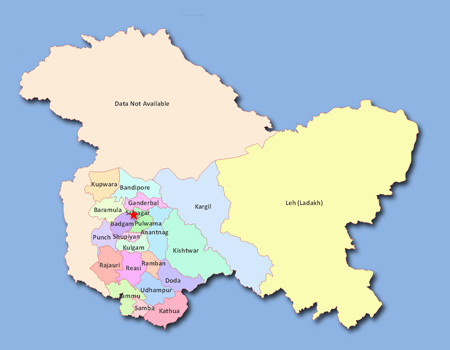
History and Geography
According to the most popular legend that is also recorded in Rajtarangani and Nilmat Fur ana, two most authoritative books, Kashmir was once a large lake, and it was Kashyap Rishi who drained off the water, making it a beautiful abode. But geologists have their own theory, which says that geographical changes made way for the outflow of water by subsidence of the mountain at Khadianayar, Baramulla, and thus emerged the Valley of Kashmir, the paradise on earth. Ashoka introduced Buddhism to Kashmir in the 3rd century B.C., which was later strengthened by Kanishka. The Huns gained control of the valley in the early 6th century. The Valley regained freedom in 530 AD, but soon came under the rule of the Ujjain empire. After the decline of the Vikramaditya dynasty, the valley had its own rulers. There was a synthesis of Hindu and Buddhist cultures. Lalitaditya (697-738 AD) extended his rule up to Bengal in the east, Konkan in the south, Turkistan in the north-west, and Tibet in the north-east. Considered the most famous Hindu ruler, he was known for constructing beautiful buildings. Islam came to Kashmir during the 13th and 14th centuries AD. Zain-ul-Abedin (1420-70) was the most famous Muslim ruler, who came to Kashmir when the Hindu king Sinha Dev fled before the Tatar invasion. Later, Chaks overran Haider Shah son of Zain-ul-Abedin. They continued to rule till 1586 when Akbar conquered Kashmir. In 1752, Kashmir passed from the feeble control of the Mughal emperor of the time/to Ahmed Shah Abdali of Afghanistan. The Valley was ruled by the Pathans for 67 years.
The name of Jammu figures in the Mahabharata. Recent finds of Harappan remains and artefacts of Mauryan, Kushan, and Gupta periods at Akhnoor have added new dimensions to its ancient character. The land of Jammu was divided into 22 hill principalities. Raja Maldev, one of the Dogra rulers, conquered many territories to consolidate his kingdom. Raja Ranjit Dev ruled over Jammu from 1733 to 1782. His successors were weak, and thus Maharaja Ranjit Singh annexed the territory to Punjab. He later handed over Jammu to Raja Gulab Singh, a scion of the old Dogra ruling family, who had grown powerful among Ranjit Singh's governors and had annexed almost the whole Jammu region. The State was governed by Dogra rulers till 1947, when Maharaja Hari Singh signed the Instrument of Accession in favour of the Indian Union on 26 October 1947.
Industry
The industrial sector in Jammu and Kashmir is relatively underdeveloped compared to other regions of India. However, there are small-scale industries focused on handicrafts, textiles, and food processing. The region is famous for its traditional crafts such as Pashmina shawls, carpets, and woodwork. Tourism also plays a crucial role in the local economy, with many visitors drawn to the natural beauty and cultural heritage of the area.
Handicrafts
Production of handicraft goods for the year 2010-11 stood at Rs. 1650.30 crore. The production figures for the year 2009-10 were Rs. 1000.00 crore approximately.
Exports of handicrafts have also maintained an upward trend over the years and reached Rs. 1200.47 crore during the year 2007-08. However, there was a decline of export sales to Rs. 661.27 crores during the year 2009-10. In 2010-11, export of handicrafts was estimated at Rs. 1004.10 crore.
Keeping in view the importance of Handicrafts, Handlooms, and other related traditional sectors in the state economy, the state Government is going to develop the International Trade Centre (ITC) in order to promote trade facilities and boost the exports of these export-oriented sectors.
Handloom
It is also a labour-intensive cottage industry, having considerable potential for the generation of employment opportunities. To give a boost to this industry, the State Govt is laying focus on product design and diversification, providing credit facilities, enhancing weavers' productivity through upgradation of sills and use of efficient looms. Market access to handloom products is being extended through marketing incentives and wide publicity. During the 11th Five-Year Plan GOI has introduced an Integrated Handloom Development of handloom weavers located in and outside identified handloom clusters into cohesive, self-managing, and competitive socio-economic units. Under this scheme, 10 handloom clusters and 17 Group approach Projects have been taken up at a project cost of Rs. 712.59 lakh. Out of the central share of Rs. 394.59 lakh, Rs. 221.57 lakhs have been utilized by the end of 11/2011. In the cooperative sector during the year 2011-12 (as on Nov 2011), approximately 12.42 million meters of handloom fabrics valued at Rs. 281.85 crore were produced.
Agriculture
Agriculture constitutes an important sector of the state economy, as around 70% of the population of J&K derives the greater part of their income directly or indirectly from this sector. The economy of J&K continues to be predominantly agrarian, as 49% of the total working force, with 42% as cultivators and 7% as agriculture labourers, depend directly on agriculture for their livelihood. Apart from the direct impact of agricultural growth on the generation of rural employment and incomes, its significant secondary linkages with the development of rural non-farm sectors are more crucial. Trade in agricultural outputs and inputs and services required by it and processing of its products open up additional and more significant avenues for labour absorption. Agriculture in the state, besides, has a significant contribution to the export of rare agricultural produce like saffron, honey, and basmati, and remains an important source of raw material demanded by many industries. Looking at the contribution of agriculture and allied sectors to the state economy, it has been estimated that 18,46% of GSDP (2011-12) accrue from it. The individual share of agriculture has been estimated in the range of 8-9% for 2011-12 (advance estimates).
Irrigation
Irrigation is an essential input of agriculture and is practised in all parts of the world where rainfall does not provide enough ground moisture. In areas of irregular rainfall, irrigation is used during dry spells to ensure harvests and to increase crop yields. A major constraint to the development of agriculture in J&K is the fact that only 50% of the ultimate irrigation potential of the state has been harnessed. The ultimate irrigation potential in J&K has been assessed at 1358 thousand hectare, which includes 250 thousand hectare to be developed through major and medium irrigation and 1108 thousand hectare through minor irrigation.
The net area sown in the state during 2010-11 was 732 thousand hectares whereas the gross area sown (total area sown under different crops) was 1140 thousand hectares. The mode of irrigating the crops mainly used is the canals. About 92 per cent of the net area irrigated is irrigated through canals, while tanks, tube wells and other means are also used.
Horticulture
Jammu & Kashmir is well known for its horticulture produce both in India and abroad. The state offers good scope for cultivation of all types of horticulture crops covering a variety of temperate fruits like apple, pear, peach, plum, apricot, almonds, cherry and sub-tropical fruits like mango, guava, citrus, litchi etc. Apart from this, well-known spices like saffron and zeera are cultivated in some parts of the state. Horticulture is emerging as a fast growing sector in the state. Its importance is visualised by its contribution to the state's economy which is estimated to be 7-8%. Almost 45% economic returns in agriculture sector is accounted for by horticulture produce. 5 lakh families comprising of 30 lakh people are involved in horticulture trade.
The horticulture department has reported that an estimated area of 3.35 lakh hectares was under horticulture during the year 2011-12 (Nov 2011) showing an increase of 3.04% over the previous year's area figures. In the area figures highest share of 44.10% is claimed by appled followed by 24.85% walnut.
The estimated production of fruit for the year 2011-12 (Now 2011) was reported to be 21.61 lakh tonnes estimated registering an increase of 26.23% over the fruit production figures for 2009-10. Out of total estimated fruit production for 2011-12 (Nov 2011), 1924 lah tonnes constituting 75.15% are fresh fruit and the remaining 24.85% are dry fruit. In the fruit production figures share of apple accounts for 81.26% and walnut with 9.66% share is the next major fruit.
Power
The estimated hydro power potential of the State is 20,000 Megawatts (MWs), of which 16480 MWs have been identified. Out of the identified potential, only, 2457.96 MWs or 15 per cent have been exploited so far, consisting of 758.70 MWs in State Sector from 20 power projects and 1680 MWs from three power projects under Central Sector i.e. 690 MWs (Salal Hydro Electric Project) and 480 MWs (Uri-I Hydro Electric Project) and Dulhasti 390 MWs and 120 MW (Sewa III) and 17.,5 MW from two private sector Projects. The prestige Baglihar Hydro Electricity Project, with a capacity of 450 MWs was commissioned during 2008-09.
Transport
Roads: The State is connected to the rest of the country through just one highway (NH1A), 400 km stretch (approx.) maintained by Border Roads Organization (BRO) of India. As Railway network of the State is in infancy stage, this has rendered the State totally dependent on road connectivity which provides links to the remote areas of the State. The Jammu-Srinagar National Highway (NH1 A) is considered to be the most expensive road for maintenance in the world.
A total length of 26711 kms of road is being maintained by PWD as on 31-03-2012. Out of this 12055 kms is black topped, 2515 kms metalled, 3651 kms shingled, 83 Kms fair-weather and 140 kms is jeepable. The road length maintained by the State PWD constitutes 14858 kms (18221 kms surfaced and 8490 kms unsurfaced) during 2011-12.
Railways: Because of the difficult terrain Railway network has not developed as in other parts of the country. At present Jammu is the Rail head of the State and the line has been extended upto District Udhampur only (53 kms). The work on Udhampur-Qazigund rail line is under progress and intra rail link between Qazigund to Baramulla is complete. However, the railway link of 119 km from Baramulla to Qazigund has been thrown open and 173 km railway line is under construction.
Aviation: There are three major airports in the state providing aerial transport among three regions of the State and the country. Out of the three Srinagar airport has been upgraded as international airport (named as Sheikh-ul-Alam Airport), while the facilities at Jammu and Leh airports are also being upgraded. One more airport at Kargil headquarters is connected by Dakota service.
Festivals
Jammu and Kashmir is known for its vibrant festivals that reflect the cultural diversity of the region. Some of the prominent festivals include:
- Navratri and Diwali: Celebrated with great enthusiasm in the Jammu region.
- Urs of Sheikh Noor-ud-Din: A significant Sufi festival observed in Kashmir.
- Losar: The Tibetan New Year celebrated in Ladakh with traditional rituals and festivities.
- Shikara Festival: A unique festival in Srinagar celebrating the traditional boat culture of Dal Lake.
These festivals showcase the rich cultural tapestry of Jammu and Kashmir and attract tourists from across the world.
Tourism
Jammu and Kashmir is renowned for its picturesque tourist destinations, including:
- Srinagar: Famous for its houseboats, Dal Lake, Mughal gardens, and vibrant markets.
- Gulmarg: A popular ski resort and hill station known for its scenic beauty and adventure sports.
- Pahalgam: A serene town offering trekking, fishing, and stunning views of the Lidder River.
- Leh-Ladakh: Known for its rugged landscapes, monasteries, and unique culture.
- Jammu: The winter capital with attractions like Raghunath Temple and Bahu Fort.
These tourist centers contribute significantly to the region's economy and provide visitors with unforgettable experiences amidst nature and culture.